
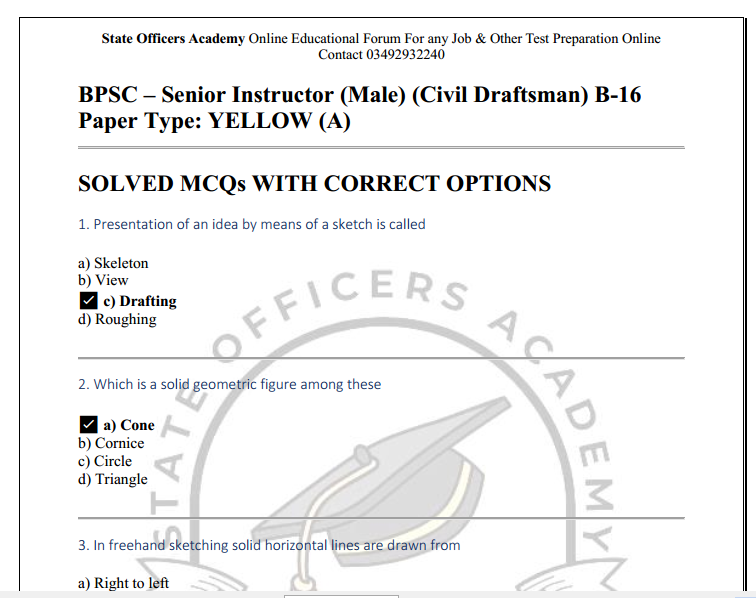
BPSC – Senior Instructor (Male) (Civil Draftsman) B-16 Solved Paper
Below is the solved paper for
BPSC Senior Instructor (Male) Civil Draftsman (B-16)
Paper Type: YELLOW (A)
with all four options retained and the correct option clearly marked.
(Prepared on standard Engineering Drawing, Building Construction, and Drafting principles.)
This page is designed for candidates and instructors preparing for the BPSC civil-drafting exam: use it for focused revision, quick practice, or classroom review. The set contains 70 practice questions with correct answers clearly indicated and concise explanations recommended in the full series.
- What’s included: all 70 MCQs (answers shown) based on standard syllabus references.
- How to use: attempt the paper in one sitting (approx. 30–45 minutes), then review answers and notes.
Quick actions: Print this page for offline practice or download the full solved paper (PDF) — see the bottom of the page for links and the study plan.
SOLVED MCQs WITH CORRECT OPTIONS
How to use this series: attempt the set as a timed practice (approx. 30–45 minutes), then review each correct answer and the brief explanation provided below. Questions are grouped by topic for focused revision: Projections & Sections, Tools & Instruments, Materials & Construction, and Measurement & Estimation. Use the page navigation to jump to any group.
1. Presentation of an idea by means of a sketch is called
a) Skeleton
b) View
✅ c) Drafting
d) Roughing
2. Which is a solid geometric figure among these
✅ a) Cone
b) Cornice
c) Circle
d) Triangle
3. In freehand sketching solid horizontal lines are drawn from
a) Right to left
✅ b) Left to right
c) Center to any side
d) Center to left
4. Standard size of drawing board “A” (American standard)
a) 12″ × 9″
b) 18″ × 12″
c) 18″ × 15″
✅ d) 24″ × 18″
5. Standard size of drawing sheet “B” (American standard)
a) 10″ × 12″
✅ b) 11″ × 8.5″
c) 11″ × 11″
d) 24″ × 18″
6. Thickness of object line is kept
✅ a) 0.5 mm
b) 1 mm
c) 1.5 mm
d) 2 mm
7. Obtuse angle
a) >45° <90°
b) >60° <90°
c) >90° <120°
✅ d) More than 90° less than 180°
8. Triangle having all three sides unequal
a) Obtuse
b) Right angle
c) Isosceles
✅ d) Scalene
9. Section drawn to know the length of the body
a) Cross section
✅ b) Long section
c) Both a & b
d) I-section
10. Passage for smoke and combustion products
a) Fire hole
✅ b) Flue
c) Float
d) Wind pipe
11. Wainscot (dado) refers to
✅ a) Lower part of the wall is different from the rest
b) Upper side of wall
c) Chemical spraying
d) None
12. Section showing details with dotted lines
a) Revolved
b) Phantom
✅ c) Offset section
d) Detailed
13. The isometric scale is nearly
✅ a) 82% of normal scale
b) 67.5%
c) 62.5%
d) 100%
14. Surface pattern drawing is called
✅ a) Development
b) Rotation
c) Circulation
d) Progression
15. View showing true size of inclined surface
a) Front view
b) Top view
c) Side view
✅ d) Auxiliary view
16. Reference line dividing object equally
a) Bilateral
b) Secondary
c) Unilateral
✅ d) Symmetrical
17. Bags of cement in one tonne
a) 20
b) 12
c) 10
✅ d) 20 (1 bag ≈ 50 kg)
18. Brick laid with breadth parallel to wall face
a) Stretcher
✅ b) Header
c) Closer
d) None
19. Site selection & orientation objective
a) House designing
✅ b) House planning
c) Execution
d) Marketing
20. Stairs and stores ideally kept
a) North
b) South
c) East
✅ d) West
21. Circulation of air
a) Orientation
b) Development
✅ c) Ventilation
d) Cultivation
22. Under side of an arch
✅ a) Intrados
b) Extrados
c) Soffit
d) Haunch
23. Intermediate support of an arch
a) Abutment
✅ b) Pier
c) Crown
d) Spandrel
24. Minimum width of stair flight (ft)
a) 1
b) 2
✅ c) 2.5
d) 3
25. Lowest member of shutter
a) Frieze rail
b) Middle rail
c) Lock rail
✅ d) Bottom rail
26. Writing on drawing sheet
a) Sketching
b) Numbering
✅ c) Lettering
d) Writing
27. Figure with all sides and angles unequal
a) Rhombus
b) Trapezium
✅ c) Scalene polygon
d) Ellipse
28. Pencil for light lines
a) 2H
✅ b) 8H
c) 6H
d) 4H
29. Door suggested for bathroom
a) Louvered
b) Sliding
✅ c) Flush door
d) Revolving
30. Stone shaping method
a) Heating
b) Throating
✅ c) Dressing
d) Moulding
31. Bricks per cubic meter
a) 350
✅ b) 500
c) 450
d) 400
32. Temporary support for foundation repair
a) Centering
✅ b) Underpinning
c) Scaffolding
d) Shuttering
33. Kankar lime
a) Lime
b) Quick
c) Fat
✅ d) Hydraulic
34. Front view location (3rd angle)
a) Above plane
b) Right side of plan
c) Below plan
✅ d) Left side of plan
35. Mortar is calculated in
a) Cubic meter / cubic feet
b) Meter / feet
c) Square meter
d) Square feet
✅ a)
36. Ellipse construction method
a) 4-center
b) Diagonal
c) Parallelogram
✅ d) All of the above
37. Surfaces of triangular prism
✅ a) 5
b) 4
c) 3
d) 7
38. Section shown separately in large size
a) Revolved
✅ b) Detailed section
c) Auxiliary
d) Removed
39. Isometric projection type
✅ a) Axonometric
b) Cabinet
c) Oblique
d) Perspective
40. Camera-like view
a) Axonometric
b) Cabinet
c) Oblique
✅ d) Perspective
41. Horizontal lines drawn by
✅ a) T-square
b) Set square
c) Protractor
d) Compass
42. Smooth curves instrument
a) Compass
b) Divider
✅ c) French curve
d) Protractor
43. Instrument with pins
✅ a) Divider
b) Compass
c) Scale
d) Drafting machine
44. Pencil sharpening tool
✅ a) Sandpaper pad
b) Eraser shield
c) Drawing board
d) T-square
45. Purpose of erasing shield
a) Dust protection
✅ b) Erase small areas
c) Shield marks
d) Clean tools
46. Circles and arcs
✅ a) Compass
b) Divider
c) French curve
d) Template
47. Drafting tape preferred
a) More adhesive
✅ b) No paper damage
c) Waterproof
d) No residue
48. Adjustable triangle draws
✅ a) 0°–90° angles
b) 30°, 60°, 90°
c) 45°, 90°
d) Circles
49. Pre-cut shapes
a) French curve
b) Compass
c) Divider
✅ d) Template
50. Bisecting a line
a) Protractor
b) Scale
✅ c) Compass & straightedge
d) French curve
51. Golden ratio construction
✅ a) Right triangle construction
b) Protractor
c) Trial
d) Templates
52. Concentric circle ellipse
✅ a) Semi-major & semi-minor axes
b) Major/minor axes
c) Foci
d) Arbitrary
53. Regular pentagon first step
a) Square
✅ b) Golden triangle
c) Hexagon
d) Octagon
54. External touching circles
✅ a) Sum of radii
b) Difference
c) Product
d) Average
55. Purpose of dimensioning
a) Beauty
✅ b) Define size & location
c) Standards
d) Many dimensions
56. Not-to-scale dimension
a) Underline
b) Parentheses
c) Color
✅ d) Asterisk
57. First-angle projection
a) Object between observer & plane
✅ b) Plane between observer & object
c) Above plane
d) Below plane
58. True size principle
a) Perspective
b) Oblique
✅ c) Orthographic
d) Axonometric
59. Principal views
a) One
b) Two
✅ c) Three
d) Six
60. Front view shows
a) Shortest dimension
✅ b) Most details
c) Simplest
d) Bottom
61. Sectional view purpose
a) Save time
✅ b) Show internal features
c) Color
d) External only
62. Half section
a) Quarter object
✅ b) Internal & external features
c) Full cut
d) Irregular
63. Removed section
a) On object
b) Hidden
✅ c) Separately shown
d) Title block
64. Not sectioned
✅ a) Shafts, bolts, nuts (longitudinal)
b) Walls
c) Gear teeth
d) Bearings
65. Offset section
a) Straight plane
✅ b) Changes direction
c) Horizontal
d) 45°
66. Lintel placed above
✅ a) Doors & windows
b) Foundation
c) Truss
d) Slab
67. Symbol ↓
✅ a) Downward direction / pipe
b) Socket
c) Window
d) Material
68. Parapet wall
a) Below ground
b) Floor level
✅ c) Above roof edge
d) Between rooms
69. Purpose of estimation
a) Profit
✅ b) Probable cost
c) Style
d) Workers
70. Detailed estimate prepared after
a) Feasibility
b) Survey
✅ c) Detailed drawings & specs
d) Soil test
Note: brief explanations and references for selected questions are provided in the downloadable PDF and in the rest of the series to help reinforce concepts for the exam. For accessibility, each correct option is annotated with an aria-label; for SEO, consider adding Question/Answer schema (JSON-LD) on the page.
SOURCE (SYLLABUS-BASED)
These MCQs are derived from standard references used in Civil Draftsman & Instructor exams. They form part of a practice series intended to help candidates prepare for the BPSC technical exam by practicing typical syllabus-based questions and checking the correct answer immediately.
Key references (please verify edition/year before citation):
• Engineering Drawing – ND Bhatt (check latest edition)
• Building Construction – Arora & Bindra (check latest edition)
• Estimation & Costing – Rangwala (check latest edition)
• BPSC prescribed Trade/Technical syllabus (official BPSC syllabus page)
• DAE Civil Drafting curriculum (PBTE / NAVTTC)
How to use this page: attempt the 70-question set, review answers, then consult the listed references or the downloadable PDF for brief explanations and practice recommendations. Recommended study plan: practice one timed set per week, review incorrect items, and focus study on Projections & Sections and Estimation & Costing topics.
If you reproduce these questions or this series on another page, please credit the sources and link back. For accuracy, confirm editions and syllabus updates from official BPSC / DAE sources.