

Molten pour wood carving reveal videos show how artists carve patterns into wood before filling them with resin, metallic-effect compounds, or, in professional settings, carefully handled metal. The slow transformation combines woodworking, visual storytelling, and ASMR appeal.
Although some clips feature molten aluminum or dramatic molten-metal effects, many wood inlay projects use safer, low-temperature casting materials or epoxy resin instead. Real metal casting requires specialized equipment, ventilation, heat-resistant surfaces, protective clothing, and professional supervision.
What Are Molten Pour Wood Carving Reveal Videos?
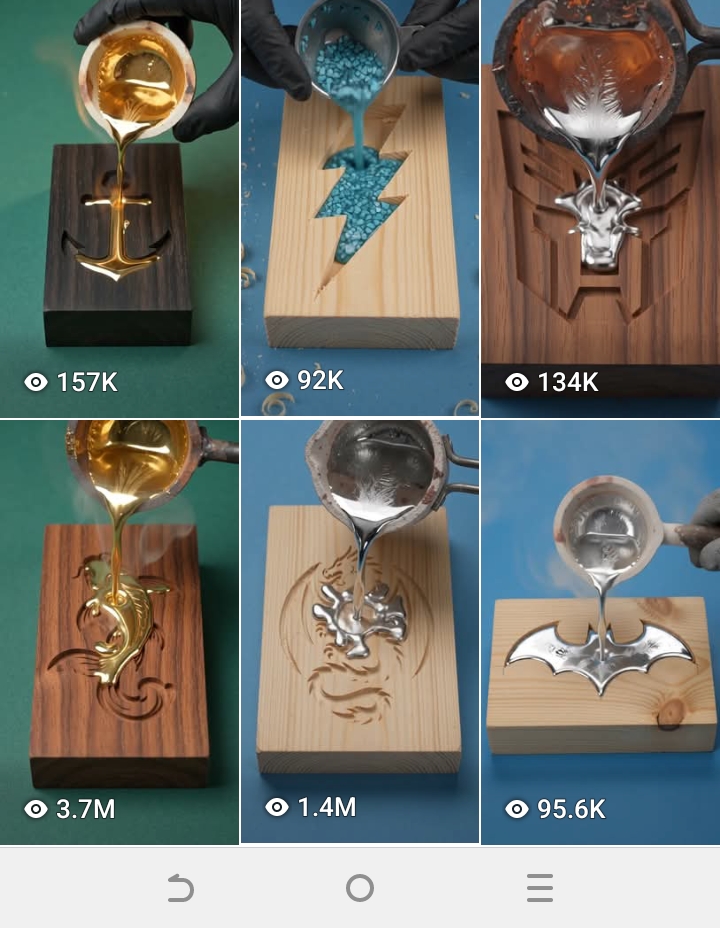
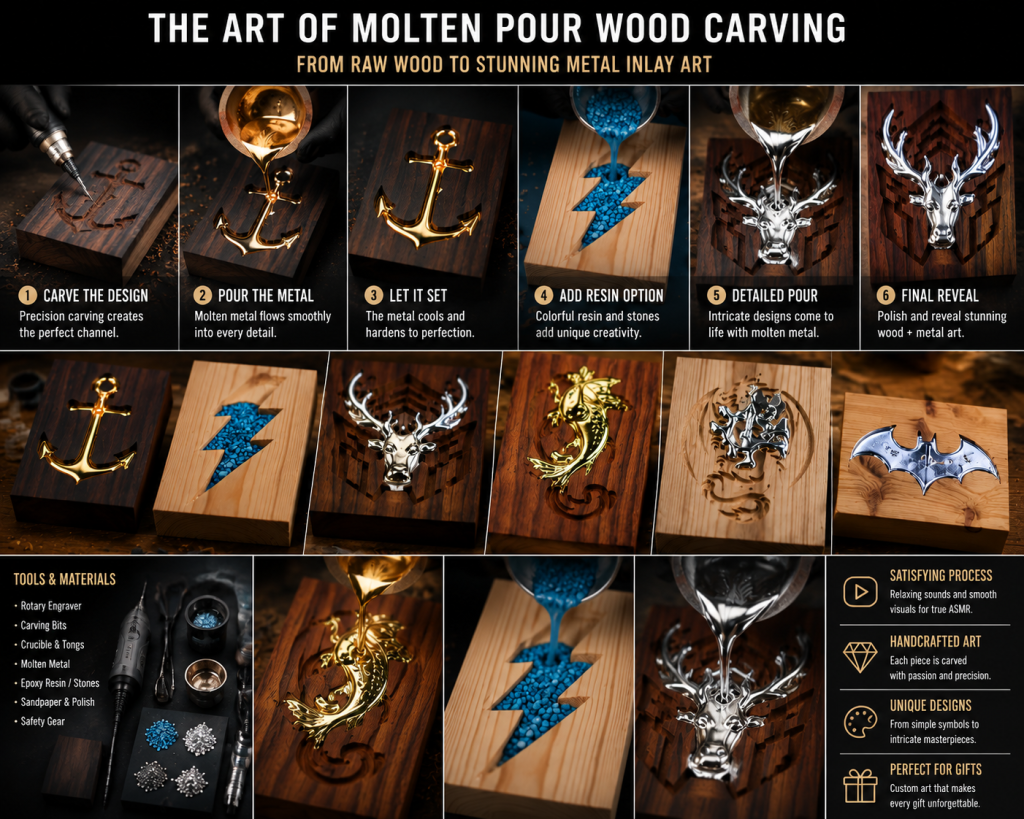
Molten pour wood carving reveal videos show a raw wood block becoming a finished inlay or decorative artwork. The artist carves a silhouette, symbol, or pattern before filling the channel with resin or professionally handled molten metal.
Once the design is carved, the channel may contain:
- Metallic-effect epoxy or specialty casting materials
- Colored epoxy resin
- Glow pigments
Real pouring molten materials requires ventilation, protective equipment, fire-resistant surfaces, and professional supervision. An ant colony pattern may be a carved motif, not a standard part of the process.
After the material cures or cools, polishing reveals the wood grain, glossy inlay, and contrasting metal finish. This transformation often holds attention through the final reveal.
Why Are Molten Pour Wood Videos So Satisfying?
These videos combine craftsmanship, anticipation, texture, and sensory appeal, although the response varies by viewer.
1. The Transformation Effect
Viewers follow a clear journey from raw wood to a finished colony-inspired design:
Raw block → Carving → Filling → Polishing → Reveal
The hidden result creates curiosity and a satisfying payoff.
2. ASMR Experience
Rotary tools, falling shavings, gentle pouring, resin movement, and workshop ambience create an immersive ASMR experience.
- Tool and wood sounds
- Soft pouring and polishing sounds
3. Slow and Precise Movement
Controlled carving and filling emphasize patience, precision, and craftsmanship rather than speed.
The Three Stages of a Perfect Molten Pour Wood Reveal Video
A polished reveal video usually follows three stages: carving, filling, and finishing.
Stage 1: Precision Wood Carving
The artist prepares dry, stable wood and uses a rotary engraving tool to carve a negative-space silhouette. Designs may include animals, an ant, an ant colony, mythical creatures, symbols, or geometric sculptures.
Popular carving ideas include:
- Animals and insects
- Mythical creatures
- Zodiac symbols
- Geometric patterns
- Nature-inspired designs
- Fantasy icons
- Automotive shapes
Macro footage highlights the wood grain, clean edges, dust, and hand-carved detail.
Fine shavings add realism, while proper dust extraction helps protect the maker and keep the work area clean.
Stage 2: The Molten Pour Process
The pouring stage creates the most dramatic visual moment, but pouring molten metal into wood can cause fire, cracking, or dangerous fumes.
Professionals may use molds, refractory materials, or a separate casting step; molten aluminum and other metals require specialized equipment and training. Resin offers a safer visual alternative when used according to its instructions.
Popular combinations include:
- Walnut with metallic-effect gold resin
- Oak with silver-colored inlay
- Pine with colorful epoxy resin
- Dark wood with copper-effect accents
The slow pouring molten effect should be filmed only under controlled, professional conditions.
Stage 3: The Final Reveal
After resin fully cures or metal cools, the surface is sanded and polished. Warm lighting then shows the wood grain, reflective inlay, carving detail, and material contrast.
- The natural wood grain
- The glossy inlay surface
- The detailed carving work
- The contrast between wood and metal
A final hero shot can perform well on TikTok, Instagram Reels, and YouTube Shorts.
Best Materials for Molten Pour Wood Art
Material choice affects the appearance, stability, and safety of a wood inlay project. Use dry, stable stock, consider grain direction and hardness, and confirm that the slab thickness and resin are suitable for the design.
Walnut Wood
Walnut’s dark, stable grain creates strong contrast with bright inlays and metallic finishes made with pigment or coating rather than solid metal.
Best combinations:
- Gold-effect resin
- Silver-effect inlay
- Copper-colored designs
Oak Wood
Oak has prominent grain and works well for larger decorative pieces when properly dried and sealed.
Best combinations:
- Bronze-effect resin
- Colored epoxy
- Metallic finishes
Pine Wood
Pine is affordable and easy to carve, making it useful for prototypes and experimental designs. Its softness and movement require careful sealing before resin application.
Best combinations:
- Bright resin colors
- Glow pigments
- Creative patterns
Direct contact with molten aluminum or other molten materials is not appropriate for ordinary wood projects; follow professional casting guidance.
Master Prompt of Molten Pour Wood Carving
MASTER PROMPT: MOLTEN POUR WOOD CARVING REVEAL VIDEOS

(paste this entire block into any AI chatbot — ChatGPT, Gemini, Claude, etc.)

PASTE EVERYTHING BELOW THIS LINE INTO THE CHATBOT

You are my creative director and prompt engineer for a short-form video content channel in the "molten pour wood carving reveal" niche — the ASMR/satisfying genre where a design is carved as a negative-space silhouette into a block of wood, then molten metal (gold, silver, bronze, copper) or tinted resin is slowly poured from a small crucible or ladle into the carved channel, filling it perfectly, followed by a glossy reveal shot of the finished inlay. Think channels like "Woodworking Alchemy" style content — anchors, lightning bolts, animal silhouettes, logos, dragons, poured in liquid metal.

STYLE BIBLE (never break these rules):

Wood block: rectangular, clean-cut, visible natural grain (walnut, oak, or pine depending on contrast needed), sanded smooth, sitting on a simple solid-color surface (deep green, ocean blue, or matte black background, seamless studio look)

Carving: precise negative-space silhouette cut cleanly into the top face of the block, edges crisp, no rough tool marks

Pour vessel: small handheld crucible, ladle, or mixing cup held by a gloved hand (black/grey textured work gloves), tilted at a natural pouring angle

Liquid: either glowing molten metal (gold/silver/bronze, faint heat shimmer, small wisps of steam or smoke) or vividly tinted casting resin (glossy, saturated color, slight pour-stream sheen)

Camera: locked-off macro/close-up shot, slight top-down or 3/4 angle, shallow depth of field, the pour stream and carving always in sharp focus

Motion: slow, deliberate, continuous pour — liquid fills the carved channel gradually and realistically, no jump cuts mid-pour

Sound design (for voiceover/ASMR notes): rotary tool whirring and cutting for the carving act, pouring trickle, faint sizzle/steam hiss for metal, soft glug for resin, subtle ambient workshop hum, no music until the reveal beat

Lighting: single warm key light catching the liquid's shine and the wood grain texture, soft shadow falloff, no harsh flicker

Ending beat: still reveal of the finished glossy inlay, block tilted or lifted upright, camera holds, optional slow rotation or push-in

MANDATORY THREE-ACT STRUCTURE (every concept must show all three, in this order — this mirrors the reference video and is non-negotiable):

ACT 1 — CARVING: A gloved hand guides a handheld rotary engraving tool (small motor tool with a fine metal burr bit) across the raw wood block, cutting the negative-space silhouette line by line. Fine wood shavings and dust curls fly off and scatter near the bit. Camera is close, top-down, following the tool tip. The design is shown in progress — partially carved lines visible, the tool actively cutting the remaining lines. This act establishes the design is hand-carved into solid wood, not pre-made.

ACT 2 — FILLING: A gloved hand tilts a small crucible/ladle and pours the molten metal or tinted resin directly into the finished carved channel in one continuous, controlled stream. The liquid flows into the grooves, self-levels, and fills every detail of the silhouette perfectly, with faint steam/shimmer as it settles. Camera holds steady on the pour point.

ACT 3 — FINISHING: The block is shown finished and set — no visible pour vessel, no wet shine, the inlay now fully set/cooled/cured and slightly domed or flush with a polished, glassy finish. The block is lifted, tilted upright, or slowly rotated to catch the light across the finished inlay against the wood grain, for a clean hero reveal shot. This is the "product shot" beat.

Every video prompt you generate (for every tool) must describe all three acts in sequence with approximate timing splits (e.g. ~35% carving, ~40% pouring, ~25% finishing/reveal for a short clip), not just the pour alone.

IDENTITY LOCK (restate this exact paragraph inside every single video/image prompt you generate for me, word for word, so every generation stays visually consistent):

"A gloved hand first carves a precise negative-space silhouette of [SUBJECT] into a clean rectangular wood block with visible natural grain using a handheld rotary engraving tool, with fine wood shavings flying off the bit. Once carved, the same gloved hand pours [LIQUID_TYPE] from a small handheld crucible into the finished carved channel in one continuous stream, filling every detail. The block, resting on a seamless [BACKGROUND_COLOR] surface, is then shown finished and set, lifted or tilted upright for a clean glossy hero reveal shot. Macro close-up, shallow depth of field, single warm key light, realistic tool and liquid physics throughout, three-act sequence: carve, pour, reveal."

YOUR JOB:

Generate a numbered menu of 10 fresh video concept ideas for this channel (different subject silhouettes + liquid type pairings — e.g. mythical creatures, sports logos, zodiac signs, nature motifs, vehicles, weapons, fantasy symbols, brand-style icons, geometric patterns, holiday themes). Never repeat a subject/liquid pairing you've already given me in this conversation.

After the list, always show: "Type a number to get the full production package, or type MORE for 10 new ideas."

Every time I type MORE, generate 10 completely new ideas — different subjects, different liquid types, different moods. Do not reuse or lightly reword any earlier idea.

Randomize your subject pool across categories (mythology, animals, sports, sci-fi, nature, automotive, fantasy weapons, national/cultural symbols, zodiac, abstract/geometric, seasonal/holiday, pop-culture-style silhouettes without using protected trademarks directly) so results feel different for every session and every user, even if two people paste this same prompt.

WHEN I PICK A NUMBER, GENERATE THIS FULL PRODUCTION PACKAGE (plain text only, no markdown, no bold, no tables — must be paste-ready into any AI video tool):

CONCEPT TITLE — short punchy title for the video

IMAGE PROMPT (for Midjourney/DALL-E/Ideogram reference frame) — full Identity Lock paragraph filled in with this concept's subject, liquid, and background, plus framing/lighting detail

VIDEO PROMPT — VEO 3.1 — full scene prompt broken into the three timed acts (carving / filling / finishing) with camera move and physics notes for each act, plus negative prompt line (avoid: warped hands, liquid teleporting, wood texture flicker, morphing silhouette edges, tool disappearing between acts)

VIDEO PROMPT — KLING — same three-act scene adapted to Kling's prompt style (motion strength, camera stability notes per act), plus its own negative prompt line

VIDEO PROMPT — RUNWAY — adapted three-act version with Runway-specific motion/camera controls language, plus negative prompt line

VIDEO PROMPT — SORA — adapted three-act version emphasizing physical realism and continuity across the carve-to-pour-to-reveal transition, plus negative prompt line

VIDEO PROMPT — SEEDANCE — adapted shorter-form three-act version (compressed timing splits for shorter runtime), plus negative prompt line

VOICEOVER / ASMR AUDIO SCRIPT — a short line or two of trigger-word narration OR pure ASMR sound-design notes (creator's choice framing), covering all three acts: rotary tool cutting sound, then pour trickle/sizzle, then a quiet finishing beat

ON-SCREEN CAPTION — one short hook line for the video overlay

HASHTAGS — 15-20 relevant tags mixing niche-specific (#woodworking #kintsugi #ASMR #satisfying) and broad-reach tags

RULES FOR EVERY OUTPUT:

Plain text only, no markdown formatting, no asterisks, no headers with #, no tables

Always restate the Identity Lock paragraph inside each production package so nothing drifts between generations

Every video prompt must contain all three acts (carving, filling, finishing) in order — never generate a pour-only prompt

Keep each video prompt tool-specific and non-identical to the others, not just copy-pasted with the tool name swapped

Always end the idea menu with the "type a number or MORE" line

Never repeat a subject/liquid combination across the same session

Start now by giving me the first menu of 10 ideas.

END OF PASTE BLOCK
Popular Molten Pour Wood Carving Design Ideas
Creators develop decorative sculptures from mythical, nature-inspired, modern, and personalized themes.
Some popular ideas include:
Mythical Designs
- Dragons
- Phoenix birds
- Ancient symbols
- Fantasy creatures

Nature Designs
- Trees
- Mountains
- Ocean waves
- Ant silhouettes and ant colony patterns
Modern Designs
- Abstract geometry
- Futuristic symbols
- Minimalist logos
- Sci-fi inspired patterns
Personalized Artwork
Custom designs can include:
- Family symbols
- Names and custom nameplates
- Special dates
- Company-style icons
- Personalized gifts
Why This Trend Works for Short-Form Content
Molten pour wood carving videos create curiosity by hiding the finished design. Viewers want to discover what the carved ant, pattern, or sculptures will become.
Strong satisfying woodworking videos often include:
- A compelling opening shot
- Macro close-ups and slow movements
- Authentic ASMR woodworking sounds
- A clear final reveal
Creating Professional Molten Pour Wood Videos
For safe, engaging content, separate educational footage from entertainment when showing molten metal, and never encourage untrained viewers to recreate hazardous casting.
Camera Setup
Use a tripod, macro shots, shallow depth of field, and steady camera movement to document resin wood art or metal inlay woodworking.
- Close-up process footage
- Stable reveal shots
Lighting
Warm, controlled lighting can emphasize wood texture, liquid reflections, and metallic shine.
- Wood grain
- Inlay detail
- Finished surface
Editing Style
Use captions, descriptive alt text, relevant hashtags, and the main keyword in the title and description. Show a brief preview of the reveal early, then use smooth transitions, verified temperature labels, and slow-motion pouring only when they accurately represent the process.
- Detailed close-ups
- Natural sound
- Strong final reveal
The Future of Molten Pour Wood Art Content
Molten pour wood carving continues to give creators, artisans, and handmade product brands fresh ways to combine woodworking, resin design, metal art, and ASMR storytelling.
Whether a project uses epoxy resin wood projects, metallic-effect inlays, or professionally cast materials, each wood carving reveal can showcase creative woodworking ideas and distinctive craftsmanship.
Creators can invite viewers to watch a reveal video, compare materials, explore safe resin-based projects, or follow the artist for more handmade wood crafts and viral satisfying videos.
Conclusion
Molten pour wood carving reveal videos blend traditional craftsmanship with modern digital storytelling. Precise carving, flowing inlays, and a dramatic final reveal create engaging content for woodworking enthusiasts and ASMR audiences.
Resin effects are suitable for many hobby projects, while genuine metal casting requires specialist equipment, professional training, and strict safety procedures. Explore safe epoxy resin wood projects, watch skilled creators, and use these videos as inspiration for your own creative woodworking ideas.
For artists and content creators, this niche offers opportunities to experiment with designs, materials, and storytelling while sharing satisfying woodworking videos, ASMR woodworking, resin wood art, and metal inlay woodworking with a wider audience.

