Candidates preparing for competitive examinations conducted by the Balochistan Public Service Commission (BPSC) can use past papers to understand question styles, revise important concepts, and identify subjects that require additional preparation.
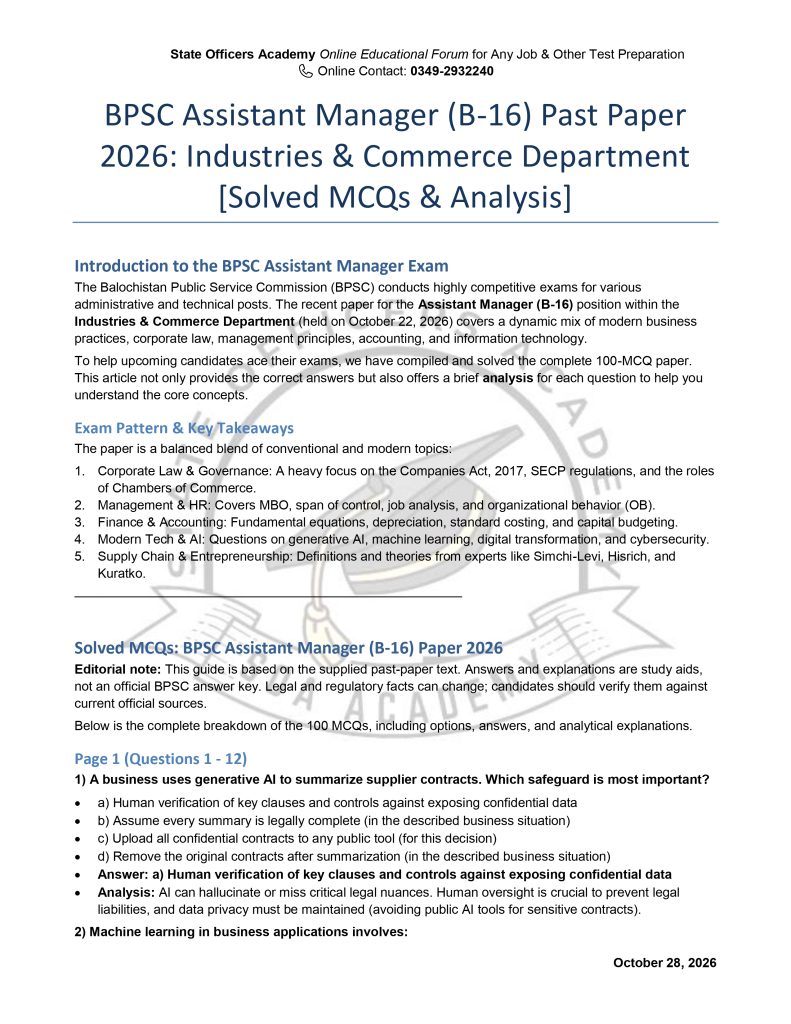
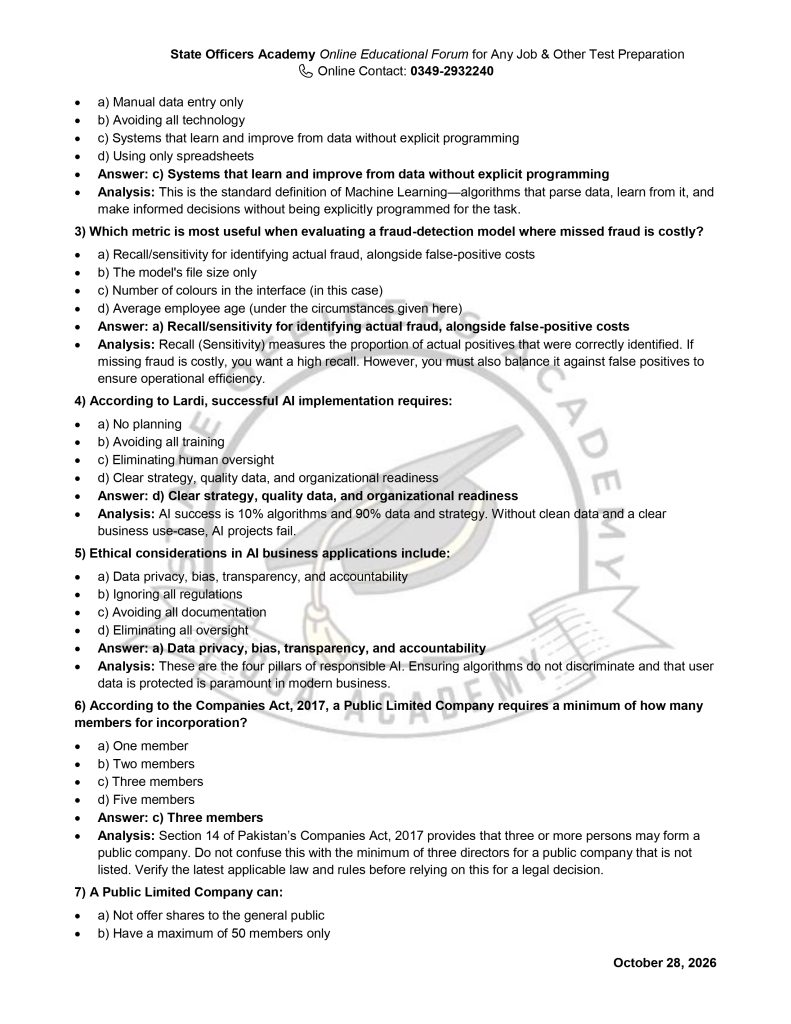
This article covers the BPSC Assistant Manager (B-16) paper for the Industries and Commerce Department dated October 22, 2026. It provides 100 multiple-choice questions (MCQs), four options for each question, the answer, and a brief explanation to support exam preparation.
The questions cover business management, corporate law, marketing, accounting, human resource management, computer applications, business mathematics, globalization, digital transformation, finance, supply chain management, and entrepreneurship.
BPSC Assistant Social Welfare Officer Past Paper 2026 – Solved 70 MCQs with Answers
Note: This is a study guide based on the supplied paper. The answers are not an official BPSC answer key. Candidates should verify legal and regulatory questions against current official sources.
BPSC Assistant Manager B-16 Paper 2026: Important Topics
The supplied paper covers the following areas:
- Artificial intelligence and machine learning in business
- Companies Act, 2017, and corporate governance
- Securities and Exchange Commission of Pakistan (SECP)
- Chambers of Commerce and FPCCI
- Principles of management and organizational behavior
- Marketing concepts and market segmentation
- Financial and cost accounting
- Human resource management
- Computer fundamentals and MS Excel
- Business mathematics and statistics
- Globalization and foreign direct investment
- Digital transformation and leadership
- Financial management and capital budgeting
- Supply chain management
- Entrepreneurship and innovation
Candidates should study definitions, principles, practical business situations, and the distinctions between similar concepts.
Exam Pattern & Subject-Wise Analysis
Based on the paper, the 100 MCQs were distributed across the following core domains:
| Subject Area | Approx. Weightage | Key Topics Focused |
|---|---|---|
| Company Law & SECP | 25% | Companies Act 2017, Incorporation, Board Duties, SECP powers |
| Management & OB | 15% | Leadership, Conflict, MBO, Maslow’s, Organizational Culture |
| Finance & Accounting | 15% | NPV, Break-even, Accounting Equation, Costing, Capital |
| AI & IT / Computer | 15% | Generative AI, Machine Learning, Hardware/Software basics |
| Marketing & Supply Chain | 10% | 4 Ps, Penetration Pricing, Bullwhip Effect, SCM |
| HRM & Entrepreneurship | 10% | Job Analysis, Training, Venture Capital, Business Plans |
| Business Math & Global | 10% | Probability, FDI, Globalization, Emerging Markets |
Key Takeaways for Future Aspirants:
- Companies Act 2017 is Crucial: A significant number of questions were directly tied to corporate laws, the role of the SECP, and board governance.
- AI is the New Normal: Questions 1-5 specifically targeted AI implementation, ethics, and fraud detection, showing a shift toward modern business practices.
- Conceptual Clarity: Most questions were definition-based or scenario-based. Rote memorization will not work; you must understand the application of concepts (e.g., Q43 on unearned revenue, Q81 on task conflict).
Solved MCQs: BPSC Assistant Manager Past Paper 2026
Section 1: Artificial Intelligence and Business Technology
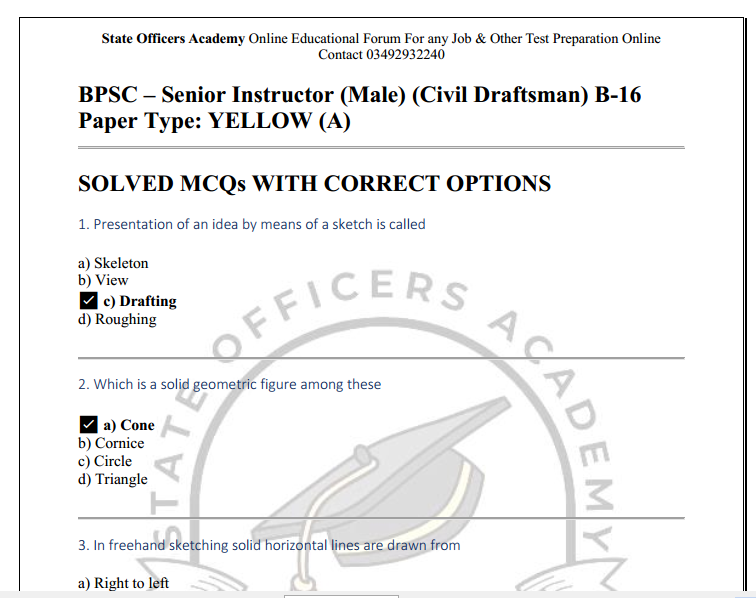
MCQ 1. A business uses generative AI to summarize supplier contracts. Which safeguard is most important?
A. Human verification of key clauses and controls against exposing confidential data
B. Assuming every summary is legally complete
C. Uploading all confidential contracts to any public tool
D. Removing the original contracts after summarization
Correct Answer: A. Human verification of key clauses and controls against exposing confidential data
Explanation: AI-generated summaries may omit important contractual conditions or produce inaccurate information. Human review and appropriate data protection are essential when processing confidential business documents.
BPSC Assistant Social Welfare Officer Past Paper 2026 – Solved 70 MCQs with Answers
MCQ 2. Machine learning in business applications involves:
A. Manual data entry only
B. Avoiding all technology
C. Systems that learn and improve from data without explicit programming for every task
D. Using only spreadsheets
Correct Answer: C. Systems that learn and improve from data without explicit programming for every task
Explanation: Machine learning uses algorithms to identify patterns in data and make predictions or decisions based on those patterns.
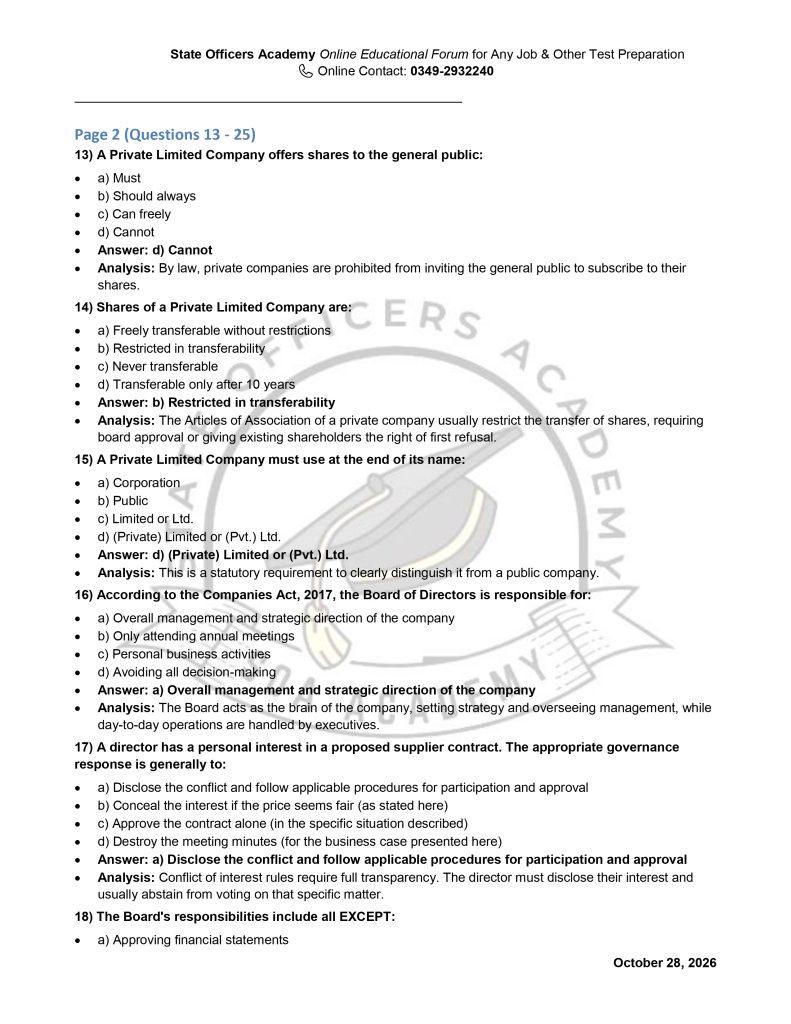
MCQ 3. Which metric is most useful when evaluating a fraud-detection model where missed fraud is costly?
A. Recall or sensitivity for identifying actual fraud, alongside false-positive costs
B. The model’s file size only
C. The number of colours in the interface
D. Average employee age
Correct Answer: A. Recall or sensitivity for identifying actual fraud, alongside false-positive costs
Explanation: Recall measures the proportion of actual positive cases correctly identified. A high recall helps reduce missed fraud, although false positives must also be considered.
MCQ 4. According to the supplied paper, successful AI implementation requires:
A. No planning
B. Avoiding all training
C. Eliminating human oversight
D. Clear strategy, quality data, and organizational readiness
Correct Answer: D. Clear strategy, quality data, and organizational readiness
Explanation: AI implementation requires a defined business objective, reliable data, suitable technology, trained employees, and effective governance.
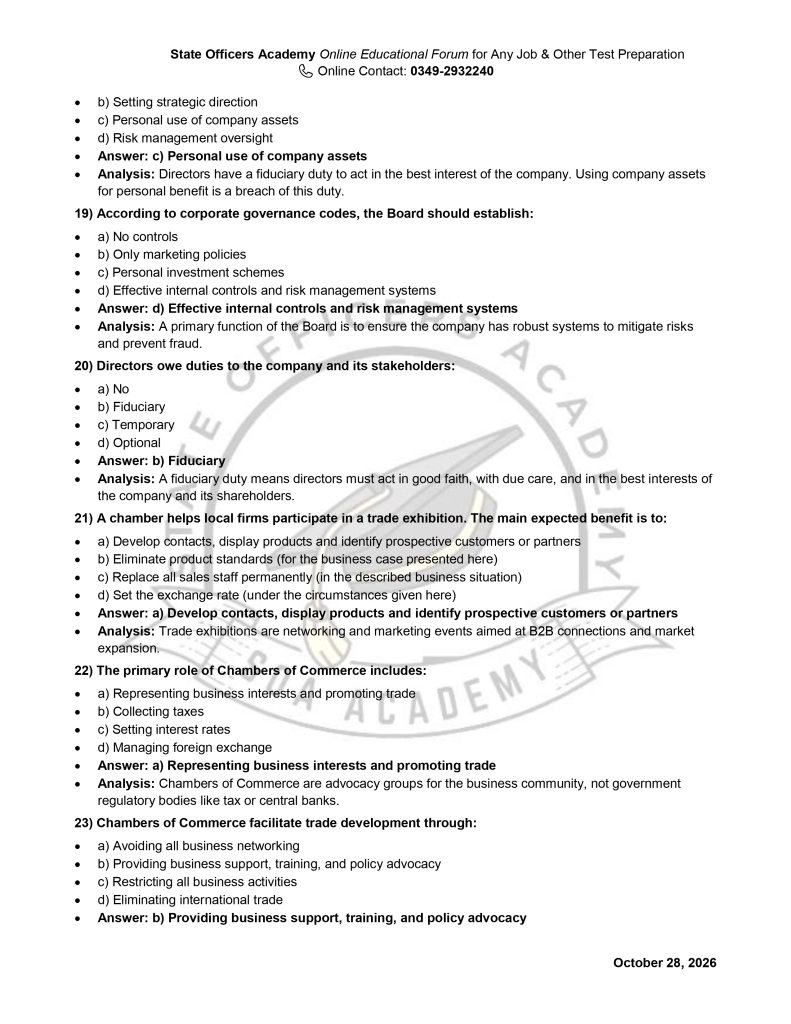
MCQ 5. Ethical considerations in AI business applications include:
A. Data privacy, bias, transparency, and accountability
B. Ignoring all regulations
C. Avoiding all documentation
D. Eliminating all oversight
Correct Answer: A. Data privacy, bias, transparency, and accountability
Explanation: Responsible AI practices address privacy, fairness, explainability, accountability, and the risks of inappropriate automated decisions.
Section 2: Companies Act, 2017, and Corporate Governance
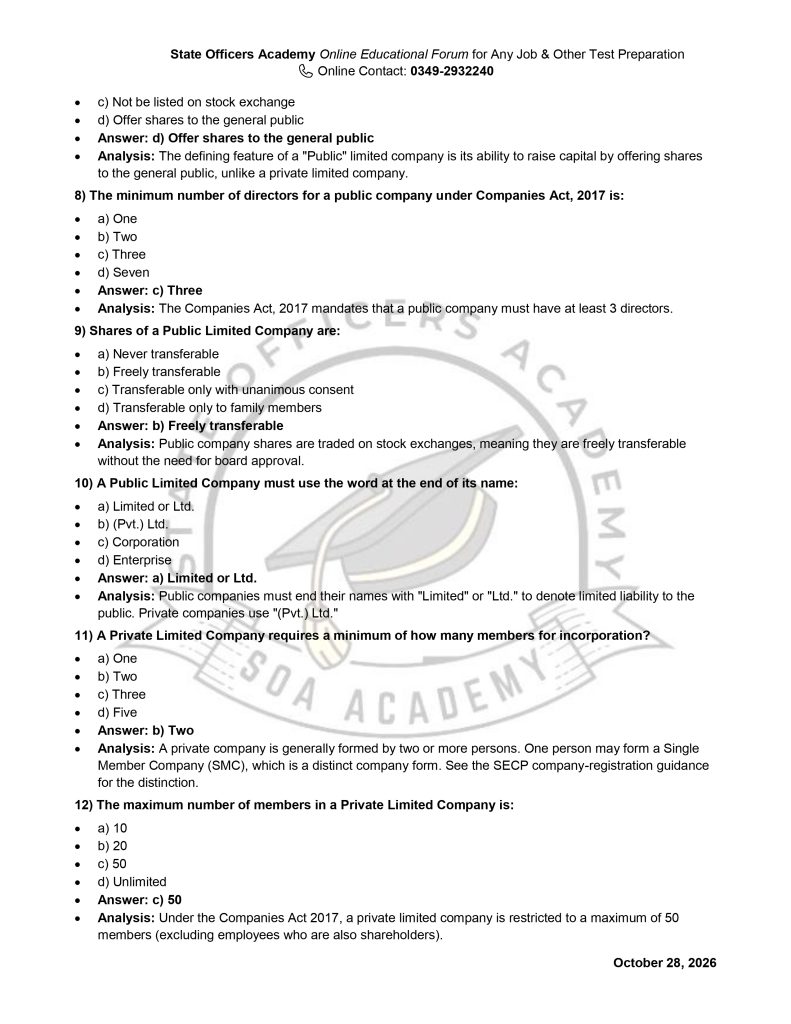
MCQ 6. According to the Companies Act, 2017, a public limited company requires a minimum of how many members for incorporation?
A. One member
B. Two members
C. Three members
D. Five members
Answer supplied in the revised study guide: C. Three members
Explanation: Section 14 of Pakistan’s Companies Act, 2017 provides for three or more persons to form a public company. Candidates should consult the current legislation and applicable rules before relying on statutory details.
MCQ 7. A public limited company can:
A. Never offer shares to the general public
B. Have a maximum of 50 members only
C. Never be listed on a stock exchange
D. Offer shares to the general public
Correct Answer: D. Offer shares to the general public
Explanation: A public company may raise capital from the public subject to applicable company and securities laws. Not every public company is necessarily listed on a stock exchange.
MCQ 8. The minimum number of directors for a public company under the Companies Act, 2017 is generally:
A. One
B. Two
C. Three
D. Seven
Correct Answer: C. Three
Explanation: A public company generally requires at least three directors under the applicable provisions. Candidates should distinguish director requirements from membership requirements.
MCQ 9. Shares of a public limited company are generally:
A. Never transferable
B. Freely transferable, subject to applicable law
C. Transferable only with unanimous consent
D. Transferable only to family members
Correct Answer: B. Freely transferable, subject to applicable law
Explanation: Public-company shares are generally transferable, although legal requirements and restrictions applicable to particular securities may apply.
MCQ 10. A public limited company generally uses which designation at the end of its name?
A. Limited or Ltd.
B. (Pvt.) Ltd.
C. Corporation only
D. Enterprise
Correct Answer: A. Limited or Ltd.
Explanation: The designation distinguishes a public limited company from a private limited company, which generally uses the private-company designation.
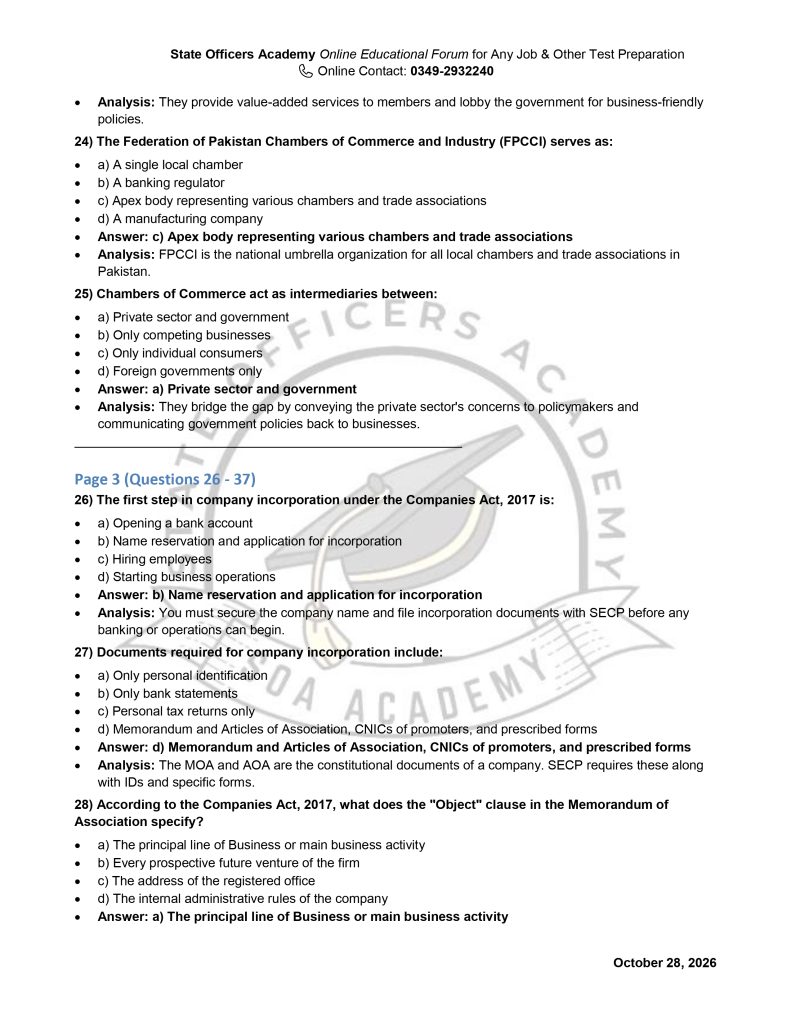
MCQ 11. A standard private limited company generally requires a minimum of how many members?
A. One
B. Two
C. Three
D. Five
Correct Answer: B. Two
Explanation: A standard private company is generally formed by two or more persons. A Single Member Company (SMC) is a distinct form that may be formed by one person.
MCQ 12. The maximum number of members in a private company under the general statutory definition is:
A. 10
B. 20
C. 50
D. Unlimited
Correct Answer: C. 50
Explanation: The general statutory definition limits a private company’s membership to 50, subject to the applicable statutory treatment of employee-members and other provisions.
MCQ 13. A private limited company can invite the general public to subscribe to its shares:
A. Must
B. Should always
C. Can freely
D. Cannot
Correct Answer: D. Cannot
Explanation: A private company is subject to restrictions on inviting the public to subscribe for its securities.
MCQ 14. Shares of a private limited company are generally:
A. Freely transferable without restrictions
B. Subject to restrictions on transferability
C. Never transferable
D. Transferable only after 10 years
Correct Answer: B. Subject to restrictions on transferability
Explanation: Private companies commonly have restrictions on share transfers under their governing documents and applicable law.
MCQ 15. A private limited company generally uses which designation in its name?
A. Corporation
B. Public
C. Limited or Ltd. only
D. (Private) Limited or (Pvt.) Ltd.
Correct Answer: D. (Private) Limited or (Pvt.) Ltd.
Explanation: The private-company designation identifies the company as a private limited company.
MCQ 16. Under corporate governance principles, the Board of Directors is responsible for:
A. Overall management oversight and strategic direction
B. Only attending annual meetings
C. Conducting directors’ personal business
D. Avoiding decision-making
Correct Answer: A. Overall management oversight and strategic direction
Explanation: The board oversees strategy, governance, risk, and senior management. Day-to-day operational responsibilities may be delegated to executives.
MCQ 17. A director has a personal interest in a proposed supplier contract. What should the director generally do?
A. Disclose the conflict and follow applicable approval procedures
B. Conceal the interest if the price seems fair
C. Approve the contract alone
D. Destroy the meeting minutes
Correct Answer: A. Disclose the conflict and follow applicable approval procedures
Explanation: Disclosure of conflicts of interest promotes transparency and helps ensure that decisions are made in accordance with applicable governance requirements.
MCQ 18. The Board’s responsibilities include all EXCEPT:
A. Approving financial statements where required
B. Setting strategic direction
C. Personal use of company assets
D. Risk management oversight
Correct Answer: C. Personal use of company assets
Explanation: Directors must comply with their legal duties and act in accordance with the company’s interests and applicable governance rules.
MCQ 19. According to corporate governance principles, the board should establish:
A. No controls
B. Only marketing policies
C. Personal investment schemes
D. Effective internal controls and risk management systems
Correct Answer: D. Effective internal controls and risk management systems
Explanation: Internal controls help protect assets, improve the reliability of reporting, support legal compliance, and reduce the risk of fraud.
MCQ 20. Directors owe duties to the company that include fiduciary duties. These duties require directors to:
A. Avoid all decisions
B. Act in accordance with their legal duties and the company’s interests
C. Put personal interests first
D. Treat compliance as optional
Correct Answer: B. Act in accordance with their legal duties and the company’s interests
Explanation: Fiduciary duties generally involve good faith, loyalty, proper purpose, and acting in accordance with applicable legal obligations.
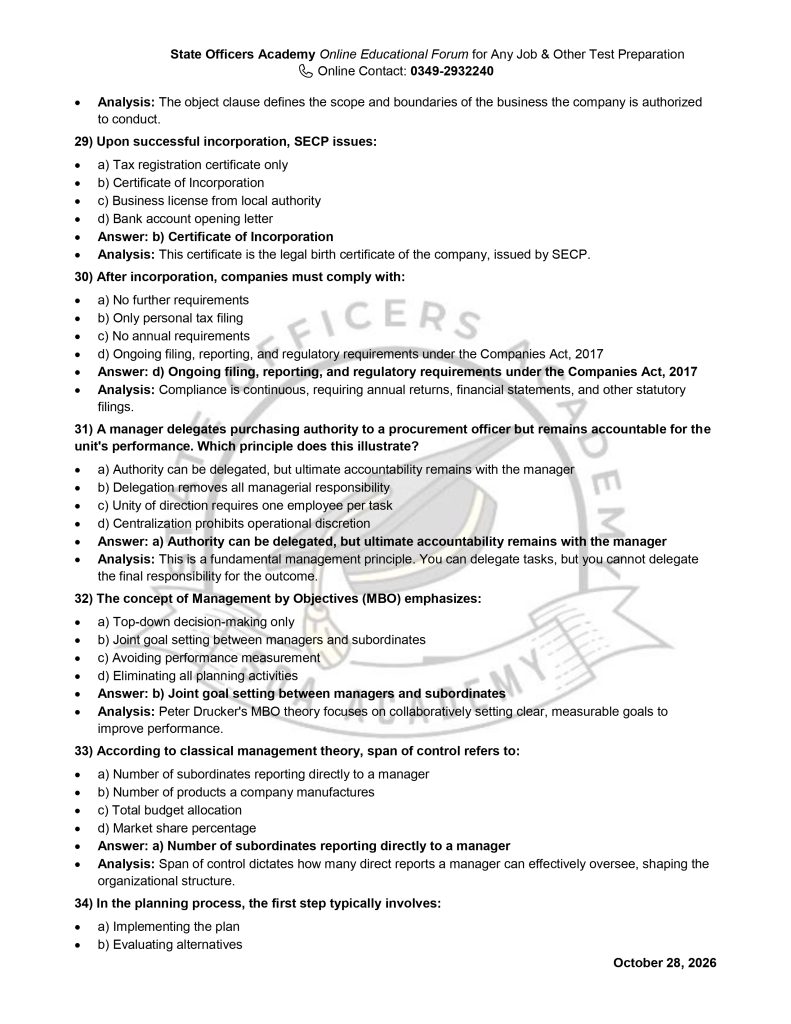
Section 3: Chambers of Commerce and Business Development
MCQ 21. A chamber helps local firms participate in a trade exhibition. The main expected benefit is to:
A. Develop contacts, display products, and identify prospective customers or partners
B. Eliminate product standards
C. Replace all sales staff permanently
D. Set the exchange rate
Correct Answer: A. Develop contacts, display products, and identify prospective customers or partners
Explanation: Trade exhibitions help businesses showcase products, develop business relationships, and explore potential markets.
MCQ 22. The primary role of Chambers of Commerce includes:
A. Representing business interests and promoting trade
B. Collecting income tax
C. Setting interest rates
D. Managing foreign exchange reserves
Correct Answer: A. Representing business interests and promoting trade
Explanation: Chambers of Commerce commonly represent businesses, provide member services, encourage trade, and communicate business concerns to policymakers.
MCQ 23. Chambers of Commerce facilitate trade development through:
A. Avoiding business networking
B. Providing business support, training, and policy advocacy
C. Restricting all business activities
D. Eliminating international trade
Correct Answer: B. Providing business support, training, and policy advocacy
Explanation: Chambers may provide networking opportunities, business information, training, and representation on policy matters.
MCQ 24. The Federation of Pakistan Chambers of Commerce and Industry (FPCCI) serves as:
A. A single local chamber
B. A banking regulator
C. An apex body representing chambers and trade associations
D. A manufacturing company
Correct Answer: C. An apex body representing chambers and trade associations
Explanation: FPCCI represents the wider business community through chambers and trade associations in Pakistan.
MCQ 25. Chambers of Commerce act as intermediaries between:
A. The private sector and government
B. Only competing businesses
C. Only individual consumers
D. Foreign governments exclusively
Correct Answer: A. The private sector and government
Explanation: Chambers communicate business-sector concerns to policymakers and help businesses understand relevant government policies.
Section 4: Company Incorporation and Management
MCQ 26. The first steps in company incorporation generally include:
A. Opening a bank account
B. Name reservation and an application for incorporation
C. Hiring employees
D. Starting business operations
Correct Answer: B. Name reservation and an application for incorporation
Explanation: Company registration involves following the applicable name-reservation and incorporation procedures through the Securities and Exchange Commission of Pakistan (SECP).
MCQ 27. Documents associated with company incorporation may include:
A. Only personal identification
B. Only bank statements
C. Personal tax returns only
D. The Memorandum and Articles of Association, identification documents, and prescribed forms, as applicable
Correct Answer: D. The Memorandum and Articles of Association, identification documents, and prescribed forms, as applicable
Explanation: The required documents depend on the company type and applicable registration procedure. Candidates should review current SECP guidance.
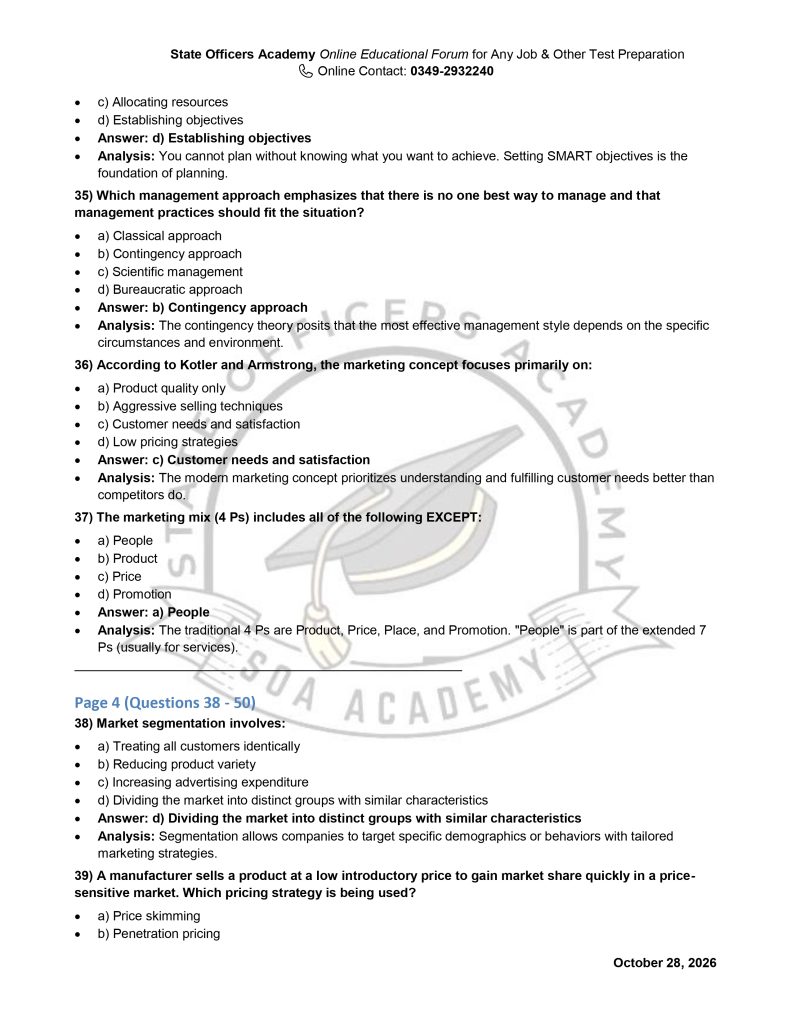
MCQ 28. What does the object clause in the Memorandum of Association generally specify?
A. The company’s principal business objectives or activities
B. Every possible future venture
C. Only the registered office address
D. Internal administrative rules exclusively
Correct Answer: A. The company’s principal business objectives or activities
Explanation: The Memorandum of Association contains key information about the company, including its lawful objectives as specified under the applicable framework.
MCQ 29. Upon successful incorporation, SECP issues:
A. Only a tax registration certificate
B. A Certificate of Incorporation
C. A local business licence in every case
D. A bank account opening letter
Correct Answer: B. A Certificate of Incorporation
Explanation: The Certificate of Incorporation confirms that the company has been incorporated under the relevant company law.
MCQ 30. After incorporation, companies must comply with:
A. No further requirements
B. Only personal tax filing
C. No annual requirements
D. Ongoing filing, reporting, and regulatory requirements applicable to the company
Correct Answer: D. Ongoing filing, reporting, and regulatory requirements applicable to the company
Explanation: Incorporation does not end a company’s compliance obligations. Applicable requirements may include statutory filings, financial reporting, tax obligations, and regulatory disclosures.
MCQ 31. A manager delegates purchasing authority to a procurement officer but remains accountable for the unit’s performance. Which principle does this illustrate?
A. Authority can be delegated, but managerial accountability remains
B. Delegation removes all responsibility
C. Unity of direction requires one employee per task
D. Centralization prohibits operational discretion
Correct Answer: A. Authority can be delegated, but managerial accountability remains
Explanation: Delegation transfers specified authority and tasks, but it does not automatically remove the manager’s accountability for overall performance.
MCQ 32. Management by Objectives (MBO) emphasizes:
A. Top-down decisions only
B. Joint goal setting between managers and subordinates
C. Avoiding performance measurement
D. Eliminating planning activities
Correct Answer: B. Joint goal setting between managers and subordinates
Explanation: MBO involves setting measurable objectives, monitoring progress, and evaluating performance against agreed goals.
MCQ 33. Span of control refers to the:
A. Number of subordinates reporting directly to a manager
B. Number of products manufactured
C. Total budget allocation
D. Market share percentage
Correct Answer: A. Number of subordinates reporting directly to a manager
Explanation: Span of control describes how many direct reports a manager supervises. The appropriate span depends on the work, employees’ experience, and organizational structure.
MCQ 34. The first step in the planning process typically involves:
A. Implementing the plan
B. Evaluating alternatives
C. Allocating resources
D. Establishing objectives
Correct Answer: D. Establishing objectives
Explanation: Objectives define what the organization wants to achieve and guide the selection of strategies and actions.
MCQ 35. Which management approach states that there is no single best way to manage every situation?
A. Classical approach
B. Contingency approach
C. Scientific management
D. Bureaucratic approach
Correct Answer: B. Contingency approach
Explanation: The contingency approach argues that management methods should fit the situation, including the environment, task, people, and organizational needs.
Section 5: Marketing Management
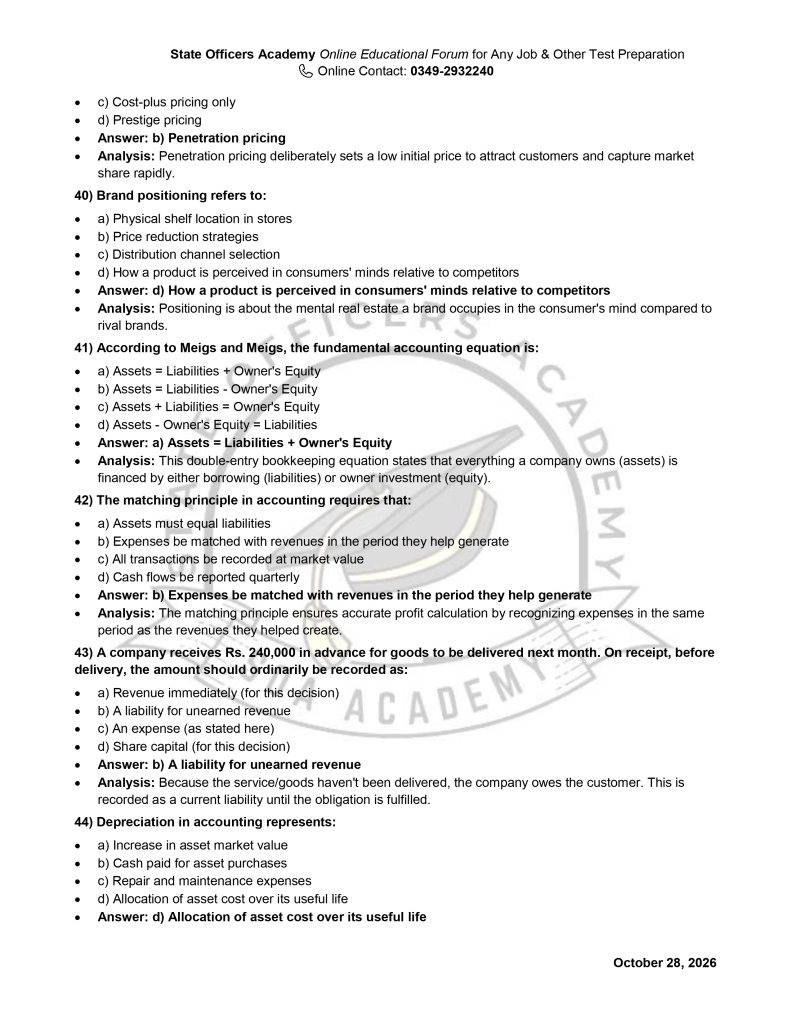
MCQ 36. According to the marketing concept, the primary focus is on:
A. Product quality only
B. Aggressive selling techniques
C. Customer needs and satisfaction
D. Low pricing alone
Correct Answer: C. Customer needs and satisfaction
Explanation: The marketing concept emphasizes understanding and meeting customer needs while creating value and maintaining organizational objectives.
MCQ 37. The traditional marketing mix, known as the 4 Ps, includes all of the following EXCEPT:
A. People
B. Product
C. Price
D. Promotion
Correct Answer: A. People
Explanation: The traditional 4 Ps are Product, Price, Place, and Promotion. People is commonly included in the extended 7 Ps marketing mix for services.
MCQ 38. Market segmentation involves:
A. Treating all customers identically
B. Reducing product variety in every case
C. Increasing advertising expenditure automatically
D. Dividing a market into groups with similar characteristics or needs
Correct Answer: D. Dividing a market into groups with similar characteristics or needs
Explanation: Segmentation helps businesses develop targeted marketing strategies for customers with shared demographic, geographic, psychographic, or behavioural characteristics.
MCQ 39. A manufacturer introduces a low price to gain market share quickly in a price-sensitive market. Which strategy is being used?
A. Price skimming
B. Penetration pricing
C. Cost-plus pricing only
D. Prestige pricing
Correct Answer: B. Penetration pricing
Explanation: Penetration pricing uses a relatively low introductory price to attract customers and establish market share.
MCQ 40. Brand positioning refers to:
A. Physical shelf location only
B. Price reductions
C. Distribution-channel selection
D. How a product is perceived relative to competitors
Correct Answer: D. How a product is perceived relative to competitors
Explanation: Brand positioning concerns the place a brand occupies in customers’ minds based on its perceived features, value, quality, and differentiation.
Section 6: Accounting and Cost Management
MCQ 41. The fundamental accounting equation is:
A. Assets = Liabilities + Owner’s Equity
B. Assets = Liabilities − Owner’s Equity
C. Assets + Liabilities = Owner’s Equity
D. Assets − Owner’s Equity = Liabilities
Correct Answer: A. Assets = Liabilities + Owner’s Equity
Explanation: The equation shows that assets are financed through liabilities and the owners’ equity.
MCQ 42. The matching principle in accounting requires that:
A. Assets must equal liabilities
B. Expenses be recognized in the period in which the related revenues are earned, where applicable
C. All transactions be recorded at market value
D. Cash flows be reported quarterly only
Correct Answer: B. Expenses be recognized in the period in which the related revenues are earned, where applicable
Explanation: The matching concept supports the appropriate recognition of expenses associated with revenue. Modern financial reporting applies the relevant accounting standards.
MCQ 43. A company receives Rs. 240,000 in advance for goods to be delivered next month. Before delivery, the amount should ordinarily be recorded as:
A. Revenue immediately in every case
B. A liability for unearned revenue
C. An expense
D. Share capital
Correct Answer: B. A liability for unearned revenue
Explanation: If payment is received before the company satisfies its obligation to deliver the goods, the amount is generally recorded as a contract liability or equivalent liability until the applicable revenue-recognition conditions are met.
MCQ 44. Depreciation represents:
A. An increase in an asset’s market value
B. Cash paid for asset purchases
C. Repair and maintenance expenses
D. The systematic allocation of a depreciable asset’s cost over its useful life
Correct Answer: D. The systematic allocation of a depreciable asset’s cost over its useful life
Explanation: Depreciation allocates the depreciable amount of a tangible asset over the periods in which it provides economic benefits.
MCQ 45. Current assets are generally expected to be realized, sold, or consumed within:
A. The normal operating cycle or 12 months, subject to the applicable accounting definition
B. Six months only
C. Two years in every case
D. Five years
Correct Answer: A. The normal operating cycle or 12 months, subject to the applicable accounting definition
Explanation: Current-asset classification depends on the applicable reporting framework and operating-cycle criteria.
MCQ 46. Which type of cost remains constant in total within the relevant range as production volume changes?
A. Variable cost
B. Fixed cost
C. Semi-variable cost
D. Marginal cost
Correct Answer: B. Fixed cost
Explanation: Fixed costs, such as rent under a fixed lease arrangement, generally remain constant in total within a relevant range, although fixed cost per unit changes with output.
MCQ 47. Job-order costing is most appropriate for:
A. Custom-made or distinct products and jobs
B. Mass production of identical products only
C. Continuous process industries exclusively
D. Service industries only
Correct Answer: A. Custom-made or distinct products and jobs
Explanation: Job-order costing accumulates costs for individual jobs or orders, such as customized furniture or construction projects.
MCQ 48. The break-even point occurs when:
A. Total revenue equals total cost
B. Profit is maximized
C. Variable costs equal fixed costs
D. Sales equal variable costs only
Correct Answer: A. Total revenue equals total cost
Explanation: At the break-even point, total contribution covers fixed costs and the business earns neither a profit nor a loss.
MCQ 49. Overhead allocation is necessary to:
A. Avoid taxation
B. Increase selling prices automatically
C. Reduce direct labour costs
D. Assign indirect costs to cost objects
Correct Answer: D. Assign indirect costs to cost objects
Explanation: Overheads such as factory electricity and indirect supervision are allocated using suitable cost-allocation methods to help determine product or service costs.
MCQ 50. Standard costing involves:
A. Recording only actual costs
B. Ignoring variances
C. Eliminating all fixed costs
D. Using predetermined costs for planning and control
Correct Answer: D. Using predetermined costs for planning and control
Explanation: Standard costs are compared with actual costs to identify variances and support management decisions.
Section 7: Human Resource Management
MCQ 51. An appraisal system rates every employee as average despite clear differences in performance. Which rating error is most likely?
A. Halo effect
B. Central tendency
C. Recency effect
D. Contrast effect
Correct Answer: B. Central tendency
Explanation: Central-tendency bias occurs when an evaluator avoids high and low ratings and places most employees near the middle of the rating scale.
MCQ 52. Job analysis involves:
A. Evaluating employee performance only
B. Calculating salary structures exclusively
C. Conducting exit interviews only
D. Determining a job’s duties, responsibilities, and requirements
Correct Answer: D. Determining a job’s duties, responsibilities, and requirements
Explanation: Job analysis identifies the tasks, responsibilities, working conditions, and qualifications associated with a position.
MCQ 53. Performance appraisal is used for:
A. Terminating employees only
B. Evaluating performance and identifying improvement opportunities
C. Setting product prices
D. Conducting market research
Correct Answer: B. Evaluating performance and identifying improvement opportunities
Explanation: Appraisal systems help assess employee performance, identify development needs, and inform decisions about training and career progression.
MCQ 54. Training and development in HRM aim to:
A. Reduce employee numbers automatically
B. Increase working hours without compensation
C. Improve employee skills and competencies
D. Decrease wages in every case
Correct Answer: C. Improve employee skills and competencies
Explanation: Training develops the knowledge and skills employees need to perform their current jobs and prepare for future responsibilities.
MCQ 55. Recruitment primarily involves:
A. Attracting suitable candidates for available positions
B. Terminating poor performers
C. Reducing training budgets
D. Outsourcing every HR function
Correct Answer: A. Attracting suitable candidates for available positions
Explanation: Recruitment builds a pool of potential applicants. Selection is the subsequent process of assessing candidates and choosing an appropriate person.
Section 8: SECP and Computer Fundamentals
MCQ 56. The Securities and Exchange Commission of Pakistan derives its institutional authority primarily from:
A. The SECP Act, 1997, and applicable legislation including the Companies Act, 2017
B. The Companies Act, 2017, exclusively
C. The State Bank of Pakistan Act only
D. Federal Board of Revenue regulations only
Correct Answer: A. The SECP Act, 1997, and applicable legislation including the Companies Act, 2017
Explanation: The SECP was established under the SECP Act, 1997. Its regulatory responsibilities also arise under relevant corporate and securities legislation.
MCQ 57. Which of the following is a function of SECP?
A. Collecting all income tax
B. Regulating the corporate sector and capital markets within its jurisdiction
C. Setting the State Bank’s policy interest rate
D. Managing Pakistan’s foreign-exchange reserves
Correct Answer: B. Regulating the corporate sector and capital markets within its jurisdiction
Explanation: SECP regulates companies, securities markets, and other sectors assigned to it by law. Tax collection and monetary policy fall under different authorities.
MCQ 58. Under the Companies Act, 2017, SECP’s corporate regulatory role extends to:
A. Listed companies only
B. Foreign companies only
C. Banking institutions exclusively
D. Different categories of companies within the scope of the applicable law
Correct Answer: D. Different categories of companies within the scope of the applicable law
Explanation: SECP’s regulatory functions are not limited to listed companies. The exact requirements depend on the company category and relevant legislation.
MCQ 59. SECP’s investigative powers may include:
A. No investigative authority
B. Reviewing annual reports only
C. Approving every business contract
D. Investigating company affairs and requiring information where authorized by law
Correct Answer: D. Investigating company affairs and requiring information where authorized by law
Explanation: Regulatory investigations and requests for records help establish compliance with the applicable legal requirements.
MCQ 60. SECP may impose penalties for:
A. Market competition alone
B. Violations and contraventions of legislation it administers
C. Every personal disagreement between shareholders
D. All international trade disputes
Correct Answer: B. Violations and contraventions of legislation it administers
Explanation: Regulatory penalties depend on the relevant statutory provision, the nature of the violation, and the applicable enforcement procedure.
MCQ 61. The CPU is commonly described as:
A. The brain of the computer
B. An output device
C. A storage device only
D. A networking component
Correct Answer: A. The brain of the computer
Explanation: The central processing unit executes instructions and performs essential processing operations.
MCQ 62. RAM stands for:
A. Read Access Memory
B. Random Access Memory
C. Readily Available Memory
D. Rapid Application Memory
Correct Answer: B. Random Access Memory
Explanation: RAM provides temporary working memory for active programs and data. Conventional RAM is volatile, meaning its contents are lost when power is removed.
MCQ 63. Which of the following is an input device?
A. Monitor
B. Printer
C. Keyboard
D. Speaker
Correct Answer: C. Keyboard
Explanation: A keyboard sends text and commands to a computer. Monitors, printers, and speakers are generally output devices.
MCQ 64. In computer terminology, software refers to:
A. Physical computer components
B. Computer furniture
C. Internet cables
D. Programs and instructions that tell hardware what to do
Correct Answer: D. Programs and instructions that tell hardware what to do
Explanation: Hardware consists of physical components, while software includes operating systems, applications, and other instructions executed by a computer.
MCQ 65. MS Excel is primarily used for:
A. Word processing
B. Spreadsheet calculations and data analysis
C. Creating presentations only
D. Email communication
Correct Answer: B. Spreadsheet calculations and data analysis
Explanation: Excel organizes information into worksheets and supports formulas, calculations, charts, data analysis, and reporting.
Section 9: Business Mathematics and Statistics
MCQ 66. Linear equations in business applications are used for:
A. Artistic purposes only
B. Avoiding calculations
C. Creating presentations
D. Modeling relationships between variables
Correct Answer: D. Modeling relationships between variables
Explanation: Linear equations represent relationships between variables and can be used in cost estimation, revenue analysis, and forecasting.
MCQ 67. Break-even analysis determines the point at which:
A. Total revenue equals total cost
B. Profit is always maximized
C. Employee salaries are established
D. Marketing expenses disappear
Correct Answer: A. Total revenue equals total cost
Explanation: Break-even analysis identifies the sales level at which total contribution covers fixed costs.
MCQ 68. The mean is a measure of:
A. Central tendency
B. Dispersion only
C. Skewness only
D. Sample size
Correct Answer: A. Central tendency
Explanation: The arithmetic mean is calculated by dividing the sum of observations by the number of observations.
MCQ 69. The probability of an event ranges between:
A. −1 and +1
B. 0 and 1
C. 0 and 100 exclusively
D. Negative infinity and positive infinity
Correct Answer: B. 0 and 1
Explanation: A probability of 0 represents an impossible event, while a probability of 1 represents a certain event. Probability can also be expressed as a percentage between 0% and 100%.
MCQ 70. Mathematics of finance includes calculations involving:
A. Addition and subtraction only
B. Employee performance ratings
C. Marketing campaign design
D. Interest, annuities, and amortization
Correct Answer: D. Interest, annuities, and amortization
Explanation: Financial mathematics supports the calculation of loan repayments, investment returns, interest, and the present or future value of cash flows.
Section 10: Globalization and Digital Transformation
MCQ 71. Globalization refers to:
A. Operating only in domestic markets
B. Avoiding international trade
C. Eliminating all foreign investment
D. Increasing interconnectedness among economies and businesses worldwide
Correct Answer: D. Increasing interconnectedness among economies and businesses worldwide
Explanation: Globalization involves growing international connections through trade, investment, technology, information, and economic activity.
MCQ 72. Emerging markets are commonly characterized by:
A. Fully developed infrastructure in every sector
B. Economic development and industrialization, often accompanied by structural change
C. No population growth
D. Complete political stability
Correct Answer: B. Economic development and industrialization, often accompanied by structural change
Explanation: Emerging markets may offer growth opportunities while also facing infrastructure gaps, regulatory uncertainty, and other economic risks.
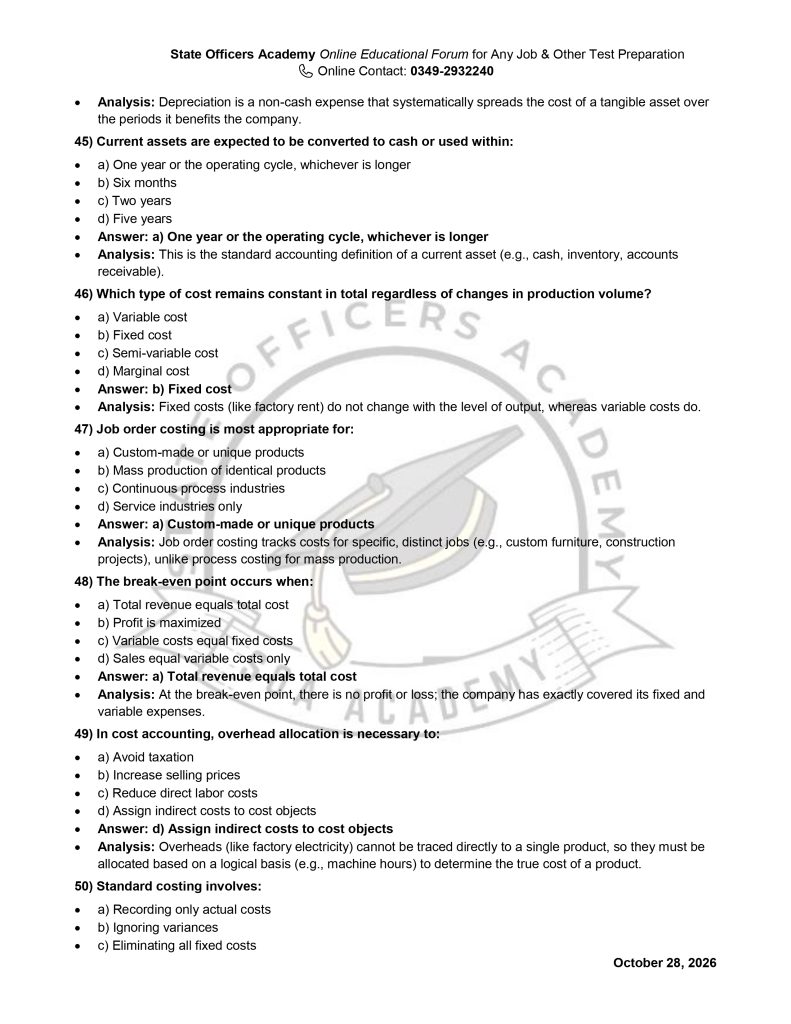
MCQ 73. Firms enter international markets to:
A. Access new customers, resources, and efficiencies
B. Avoid all competition
C. Reduce product quality
D. Eliminate all employees
Correct Answer: A. Access new customers, resources, and efficiencies
Explanation: International expansion can provide access to additional customers, suppliers, talent, resources, and economies of scale.
MCQ 74. Foreign direct investment (FDI) generally involves:
A. Short-term portfolio investment only
B. A lasting interest in a foreign enterprise, commonly involving significant influence or control
C. Exporting goods only
D. Importing services only
Correct Answer: B. A lasting interest in a foreign enterprise, commonly involving significant influence or control
Explanation: FDI differs from ordinary portfolio investment because it establishes a lasting investment relationship with a foreign enterprise.
MCQ 75. Which is a common institutional risk when entering an emerging market?
A. Regulatory uncertainty and uneven enforcement
B. Guaranteed currency stability
C. Complete absence of customer-demand risk
D. No need for local partnerships
Correct Answer: A. Regulatory uncertainty and uneven enforcement
Explanation: Changes in regulation, administrative uncertainty, inconsistent enforcement, and political risk can affect business operations and investment returns.
MCQ 76. Digital transformation involves:
A. Avoiding all technology
B. Maintaining traditional methods exclusively
C. Eliminating innovation
D. Using digital technologies to change business operations and value creation
Correct Answer: D. Using digital technologies to change business operations and value creation
Explanation: Digital transformation combines technology, strategy, people, and process changes to improve how an organization operates and delivers value.
MCQ 77. Leadership in the digital age requires:
A. Adapting to technological change and fostering innovation
B. Resisting every change
C. Avoiding data analytics
D. Maintaining hierarchical structures exclusively
Correct Answer: A. Adapting to technological change and fostering innovation
Explanation: Digital leadership involves guiding technological change, developing digital capabilities, and enabling employees to respond to changing business needs.
MCQ 78. Important elements of digital transformation include:
A. Purchasing hardware only
B. Avoiding digital platforms
C. Eliminating employee training
D. Data analytics, AI, cybersecurity, and relevant digital technologies
Correct Answer: D. Data analytics, AI, cybersecurity, and relevant digital technologies
Explanation: Digital transformation involves more than purchasing computers. It requires strategic integration of technology, secure data practices, skills, and processes.
MCQ 79. Digital leadership involves:
A. Micromanaging every technical detail
B. Creating a vision and enabling digital capabilities
C. Avoiding strategic planning
D. Working without technology
Correct Answer: B. Creating a vision and enabling digital capabilities
Explanation: Digital leaders align technology initiatives with organizational goals and help teams build the capabilities needed to implement change.
MCQ 80. A digital transformation framework should align:
A. Hardware purchases only
B. Software avoidance
C. Technology with no customer focus
D. Strategy, technology, data, and organizational capabilities
Correct Answer: D. Strategy, technology, data, and organizational capabilities
Explanation: Sustainable transformation depends on alignment among business objectives, digital systems, data governance, people, and organizational processes.
Section 11: Organizational Behavior and Leadership
MCQ 81. A team disagrees about which technical design best meets project requirements, but members respect one another. This is:
A. Relationship conflict
B. Task conflict
C. Status conflict only
D. Role overload
Correct Answer: B. Task conflict
Explanation: Task conflict concerns disagreements about work, ideas, or decisions. Relationship conflict involves interpersonal tensions and personal incompatibilities.
MCQ 82. Which factors can influence individual behavior in organizations?
A. Personality, perception, motivation, and environment
B. Salary alone
C. Office location alone
D. Company logo
Correct Answer: A. Personality, perception, motivation, and environment
Explanation: Organizational behavior studies how individual characteristics, social relationships, leadership, and workplace conditions affect behavior.
MCQ 83. Maslow’s hierarchy of needs explains:
A. Financial accounting principles
B. Motivation through a hierarchy of human needs
C. Production scheduling
D. Marketing strategies
Correct Answer: B. Motivation through a hierarchy of human needs
Explanation: Maslow’s model groups needs into physiological, safety, social, esteem, and self-actualization categories. The model is influential, although actual human motivation does not always follow a rigid sequence.
MCQ 84. Organizational culture refers to:
A. Physical office layout only
B. Employee dress code only
C. Company stationery design
D. Shared values, beliefs, assumptions, and norms
Correct Answer: D. Shared values, beliefs, assumptions, and norms
Explanation: Organizational culture influences how employees communicate, make decisions, solve problems, and respond to workplace expectations.
MCQ 85. Leadership in organizational behavior involves:
A. Influencing others toward goal achievement
B. Formal authority only
C. Avoiding decisions
D. Eliminating communication
Correct Answer: A. Influencing others toward goal achievement
Explanation: Leadership involves influencing individuals or groups to work toward shared objectives. Formal authority can help, but it is not the only source of leadership.
Section 12: Financial Management
MCQ 86. The primary objective of financial management in traditional corporate finance theory is commonly described as:
A. Maximizing sales revenue
B. Maximizing shareholder wealth
C. Minimizing every expense
D. Maximizing employee numbers
Correct Answer: B. Maximizing shareholder wealth
Explanation: Traditional corporate finance emphasizes increasing the long-term value of shareholders’ investment while considering risk, legal obligations, and other relevant constraints.
MCQ 87. All else being equal, which change is most likely to increase an existing fixed-rate bond’s market price?
A. An increase in market interest rates
B. A decrease in market interest rates
C. A decline in expected coupon payments
D. An increase in the issuer’s default risk
Correct Answer: B. A decrease in market interest rates
Explanation: Bond prices generally move inversely to market yields. When comparable market interest rates decline, an existing bond’s fixed payments become relatively more attractive.
MCQ 88. Cost of capital represents:
A. Total company revenue
B. Employee salary expenses
C. The required return associated with financing the business
D. Marketing expenditure
Correct Answer: C. The required return associated with financing the business
Explanation: Cost of capital reflects the return required by providers of finance and is used as a benchmark in investment and financing decisions.
MCQ 89. Net Present Value (NPV) is calculated by:
A. Subtracting the initial investment from the present value of future cash inflows, while accounting for relevant cash outflows
B. Adding all cash flows without discounting
C. Dividing revenue by expenses
D. Multiplying assets by liabilities
Correct Answer: A. Subtracting the initial investment from the present value of future cash inflows, while accounting for relevant cash outflows
Explanation: NPV discounts future cash flows to their present value and subtracts the initial investment and any other relevant cash outflows. A positive NPV generally indicates that a project is expected to add value at the selected discount rate.
MCQ 90. Working capital management deals primarily with:
A. Long-term investment decisions only
B. Managing short-term assets and liabilities
C. Employee recruitment
D. Product development
Correct Answer: B. Managing short-term assets and liabilities
Explanation: Working capital management concerns liquidity and the efficient management of cash, receivables, inventory, and short-term obligations.
Section 13: Supply Chain Management
MCQ 91. Supply chain management involves coordinating the flow of:
A. Manufacturing activities only
B. Marketing activities only
C. Human resource plans only
D. Goods, information, and funds from suppliers to customers
Correct Answer: D. Goods, information, and funds from suppliers to customers
Explanation: Supply chain management coordinates sourcing, production, transportation, inventory, information, and related financial flows to meet customer demand.
MCQ 92. The bullwhip effect refers to:
A. Physical damage to products
B. Employee turnover
C. Amplification of demand variability up the supply chain
D. Marketing campaign failure
Correct Answer: C. Amplification of demand variability up the supply chain
Explanation: Small changes in consumer demand can cause progressively larger fluctuations in orders placed by retailers, wholesalers, distributors, and manufacturers.
MCQ 93. Inventory management aims to:
A. Eliminate every item of inventory
B. Balance holding costs with stockout and replenishment costs
C. Maximize warehouse space only
D. Ignore customer demand
Correct Answer: B. Balance holding costs with stockout and replenishment costs
Explanation: Effective inventory management maintains sufficient stock to meet demand while controlling storage, ordering, obsolescence, and shortage costs.
MCQ 94. Strategic supplier relationships involve:
A. Long-term partnerships with important suppliers
B. One-time transactions only
C. Avoiding communication
D. Selecting suppliers on price alone
Correct Answer: A. Long-term partnerships with important suppliers
Explanation: Strategic supplier relationships can improve quality, reliability, information sharing, innovation, and long-term supply performance.
MCQ 95. Supply chain integration refers to:
A. Operating all functions independently
B. Eliminating all suppliers
C. Focusing only on internal operations
D. Coordinating activities across supply chain participants
Correct Answer: D. Coordinating activities across supply chain participants
Explanation: Integration aligns information, planning, inventory, and operational decisions among suppliers, manufacturers, distributors, and retailers.
Section 14: Entrepreneurship and Innovation
MCQ 96. An entrepreneur is generally someone who:
A. Creates and manages new business ventures
B. Works only for a fixed salary
C. Avoids every possible risk
D. Works exclusively in government
Correct Answer: A. Creates and manages new business ventures
Explanation: Entrepreneurship involves identifying opportunities, organizing resources, taking calculated risks, and developing a business or venture.
MCQ 97. A business plan typically includes all EXCEPT:
A. Executive summary
B. Market analysis
C. Personal diary entries
D. Financial projections
Correct Answer: C. Personal diary entries
Explanation: A business plan generally explains the business concept, target market, competitive environment, operational approach, marketing strategy, and financial expectations.
MCQ 98. Venture capital refers to:
A. Government grants only
B. External investment provided to startups and businesses with high growth potential
C. Personal savings only
D. Bank loans for established businesses only
Correct Answer: B. External investment provided to startups and businesses with high growth potential
Explanation: Venture capital is an equity investment used to finance businesses with significant growth potential, generally in exchange for an ownership stake.
MCQ 99. The entrepreneurial process includes:
A. Idea generation only
B. Avoiding planning
C. Working alone without a team
D. Opportunity recognition, resource acquisition, and venture management
Correct Answer: D. Opportunity recognition, resource acquisition, and venture management
Explanation: Entrepreneurship requires recognizing opportunities, assessing feasibility, securing resources, launching the venture, and managing its development.
MCQ 100. Entrepreneurial innovation involves:
A. Copying existing products exactly
B. Avoiding all change
C. Creating new or improved products, services, or processes
D. Maintaining the status quo in every situation
Correct Answer: C. Creating new or improved products, services, or processes
Explanation: Innovation creates or improves value through products, services, business models, or processes. It is an important source of differentiation and business growth.
Important Preparation Tips for the Upcoming BPSC Assistant Manager Exam
1. Revise corporate law and SECP
Study the Companies Act, 2017, company types, incorporation procedures, corporate governance, directors’ duties, and the regulatory responsibilities of SECP. Verify numerical and legal questions against current official material.
2. Practise management and marketing MCQs
Focus on Management by Objectives, span of control, delegation, contingency theory, the marketing mix, segmentation, positioning, and pricing strategies.
3. Strengthen accounting and finance
Practise the accounting equation, depreciation, fixed and variable costs, break-even analysis, standard costing, working capital, cost of capital, and Net Present Value.
4. Review computer fundamentals and digital transformation
Revise CPU, RAM, input and output devices, software, spreadsheets, machine learning, AI safeguards, data analytics, and cybersecurity.
5. Prepare business mathematics and statistics
Practise mean, probability, linear equations, interest calculations, annuities, and basic financial mathematics. Work through numerical questions rather than memorizing definitions alone.
6. Study supply chain management and entrepreneurship
Understand the bullwhip effect, inventory management, supplier relationships, supply chain integration, venture capital, business planning, and innovation.
7. Use active recall and timed practice
Attempt MCQs without looking at the answers first. Review every incorrect response, maintain a notebook of difficult concepts, and repeat the questions after a few days.
Frequently Asked Questions (FAQs)
What is the BPSC Assistant Manager (B-16) past paper?
It is a previous examination paper used to practise the question styles and subject areas relevant to the Assistant Manager post in the Industries and Commerce Department.
How many MCQs are covered in this solved paper?
This study guide covers 100 MCQs, each with four answer options, a designated answer, and an explanation.
Which subjects should candidates prepare?
The supplied paper covers corporate law, SECP, management, marketing, accounting, HRM, computer applications, mathematics, digital transformation, finance, supply chain management, and entrepreneurship.
Are these official BPSC answers?
No. The answers and explanations are study aids based on the supplied paper. Candidates should check official answer keys where available and verify legal and regulatory facts against current sources.
How should candidates prepare for similar exams?
Review past papers, understand the underlying concepts, practise timed MCQ tests, revise weak areas, and consult the current syllabus and official examination instructions.
Conclusion
The BPSC Assistant Manager (B-16) past paper provides a useful revision resource across business administration, corporate law, accounting, finance, technology, and entrepreneurship. Candidates should use the 100 solved MCQs to identify knowledge gaps and strengthen conceptual understanding before attempting further practice tests.
For the best results, combine past-paper practice with the current BPSC syllabus, official legislation, and reliable subject-specific study material.
Bookmark this page and revisit the MCQs regularly as part of your BPSC exam preparation.