Matriculation Level Mathematics | Secondary & Intermediate Detailed Guide
Real and complex numbers form the backbone of modern mathematics and play a vital role in science, engineering, economics, and technology. From basic counting and measurements to advanced electrical engineering and quantum mechanics, the concepts of real and complex numbers are unavoidable. This SEO-optimized, comprehensive article is designed especially for Matriculation and Intermediate level students, covering theory, properties, solved examples, applications, and common mistakes in a clear and structured manner.

This guide fully explains complex numbers and real numbers, their differences, operations, and real-life relevance, making it ideal for exam preparation, concept building, and revision.
1. Introduction to Real and Complex Numbers
In mathematics, numbers are classified into different systems to represent quantities, solve equations, and model real-world situations. The two most important systems studied at the secondary level are:
- Real Numbers
- Complex Numbers
Understanding the relationship between real numbers, imaginary numbers, and complex numbers is essential to progress in algebra, trigonometry, calculus, and applied sciences.
2. Real Numbers (ℝ)
Definition of Real Numbers
Real numbers include all numbers that can be represented on a number line. Every real number corresponds to a unique point on the line.
Examples include:
- Integers: −3, −1, 0, 2, 5
- Fractions: 3/4, −7/5
- Decimals: 0.25, −1.75
- Irrational numbers: √2, π
3. Classification and Hierarchy of Real Numbers
The real number system is organized in a well-defined hierarchy:
Real Numbers (ℝ)
├── Rational Numbers (ℚ)
│   ├── Integers (ℤ)
│   │   ├── Natural Numbers (ℕ) = {1, 2, 3, ...}
│   │   ├── Whole Numbers (W) = {0, 1, 2, 3, ...}
│   │   ├── Negative Integers = {−1, −2, −3, ...}
│   │   └── Zero (0)
│   └── Fractions & Decimals
│       ├── Proper Fractions (3/4)
│       ├── Improper Fractions (5/2)
│       └── Mixed Numbers (2½)
└── Irrational Numbers (𝕀)
    ├── Non-terminating, non-repeating decimals
    ├── √2, √3, √5
    └── π, e
This hierarchy helps students understand how real numbers, complex numbers, and imaginary numbers are connected.
4. Rational Numbers (ℚ)
Definition
Rational numbers are numbers that can be expressed in the form:
[
\frac{p}{q}, \quad q \neq 0
]
Examples:
- 1/2, −3/5
- 4 = 4/1
- 0.75 = 3/4
Decimal Representation
- Terminating decimals (0.25)
- Repeating decimals (0.333…)
5. Irrational Numbers (𝕀)
Irrational numbers cannot be written as p/q.
Examples:
- √2 ≈ 1.414213…
- π ≈ 3.14159…
- e ≈ 2.71828…
Their decimal expansions are non-terminating and non-repeating.
6. Properties of Real Numbers
1. Closure Property
For all real numbers a and b:
- a + b ∈ ℝ
- a × b ∈ ℝ
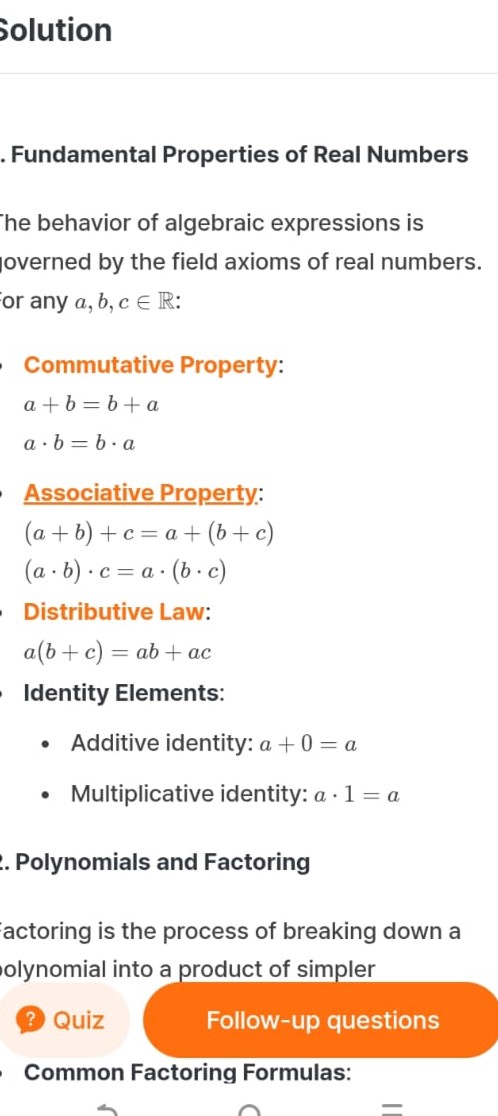
2. Commutative Property
- a + b = b + a
- a × b = b × a
3. Associative Property
- (a + b) + c = a + (b + c)
- (a × b) × c = a × (b × c)
4. Distributive Property
[
a(b + c) = ab + ac
]
5. Identity Elements
- Additive identity: a + 0 = a
- Multiplicative identity: a × 1 = a
6. Inverse Elements
- Additive inverse: a + (−a) = 0
- Multiplicative inverse: a × (1/a) = 1, a ≠ 0
7. Number Line Representation
Every real number corresponds to a unique point on the number line.
<--|-----|-----|-----|-----|-----|-----|-----|-->
  -3    -2    -1     0     1     2     3
The distance from zero is called the absolute value:
[
|a|
]
8. Operations with Real Numbers
Addition and Subtraction
Follow sign rules.
Multiplication and Division
- Same signs → Positive
- Different signs → Negative
9. Introduction to Complex Numbers

Why Complex Numbers?
Consider the equation:
[
x^2 + 1 = 0
]
This implies:
[
x^2 = -1
]
There is no real number whose square is −1. Hence, complex numbers were introduced.
10. Imaginary Numbers and the Unit i
[
i = \sqrt{-1}
]
So:
[
\sqrt{-4} = 2i
]
This introduces imaginary numbers, which are not real numbers alone but become meaningful within the complex system.
11. Definition of Complex Numbers
A complex number is written as:
[
z = a + bi
]
Where:
- a ∈ ℝ → Real part
- b ∈ ℝ → Imaginary part
- i = √−1
Thus, real and imaginary numbers together form complex numbers.
12. Types of Complex Numbers
- Purely Real Numbers
b = 0
Example: 5 = 5 + 0i - Purely Imaginary Numbers
a = 0
Example: 3i = 0 + 3i - General Complex Numbers
a ≠ 0 and b ≠ 0
Example: 4 + 5i
13. Powers of i (Cyclic Pattern)
[
i^1 = i,\quad i^2 = -1,\quad i^3 = -i,\quad i^4 = 1
]
The pattern repeats every four powers.
Example:
[
i^{23} = i^{4×5+3} = i^3 = -i
]
14. Conjugate of a Complex Number
For:
[
z = a + bi
]
The conjugate is:
[
\bar{z} = a – bi
]
Properties
- z + z̄ = 2a (real)
- z − z̄ = 2bi (imaginary)
- z × z̄ = a² + b² (positive real)
15. Operations with Complex Numbers
Addition
[
(a+bi)+(c+di)=(a+c)+(b+d)i
]
Subtraction
[
(a+bi)-(c+di)=(a-c)+(b-d)i
]
Multiplication
[
(a+bi)(c+di)=(ac-bd)+(ad+bc)i
]
Division
Multiply numerator and denominator by the conjugate of the denominator.
16. Equality of Complex Numbers
[
a+bi = c+di \iff a=c \text{ and } b=d
]
17. Geometric Representation (Argand Diagram)
- Horizontal axis → Real axis
- Vertical axis → Imaginary axis
The complex number a + bi is represented as point (a, b).
Modulus
[
|z| = \sqrt{a^2 + b^2}
]
Argument
[
\theta = \tan^{-1}(b/a)
]
18. Comparison: Real vs Complex Numbers
| Feature | Real Numbers | Complex Numbers |
|---|---|---|
| Form | a | a + bi |
| Dimension | One-dimensional | Two-dimensional |
| Ordering | Possible | Not possible |
| Roots of equations | Limited | All polynomials |
| Example | 5, √2 | 3 + 4i |
19. Solved Examples (Matric Level)
Example 1: Real Numbers
Simplify:
[
\frac{\sqrt{12} \times \sqrt{27}}{\sqrt{75}}
]
Solution:
[
= \frac{\sqrt{324}}{\sqrt{75}} = \frac{18}{5\sqrt{3}} = \frac{6\sqrt{3}}{5}
]
Example 2: Complex Numbers
If:
[
z = 2 – 3i
]
Find:
- z²
- z z̄
Answer:
[
z^2 = -5 – 12i,\quad zz̄ = 13
]
Example 3: Quadratic Equation
Solve:
[
x^2 – 4x + 13 = 0
]
Answer:
[
x = 2 \pm 3i
]
20. Practical Applications
Real Numbers
- Measurements
- Finance
- Statistics
- Physics
Complex Numbers
- Electrical engineering (AC circuits)
- Signal processing
- Control systems
- Quantum mechanics
- Computer graphics
21. Important Formulae Summary
- Modulus: |a+bi| = √(a²+b²)
- Conjugate: a−bi
- Inverse: (a−bi)/(a²+b²)
- Quadratic formula:
[
x=\frac{-b\pm\sqrt{b^2-4ac}}{2a}
]
22. Common Mistakes to Avoid
- Assuming √(−4) = −2
- Forgetting i² = −1
- Trying to order complex numbers
- Misapplying real-number rules to all complex operations
Conclusion
The study of real and complex numbers is essential for mastering mathematics at the matriculation and intermediate level. Understanding how real numbers, imaginary numbers, and complex numbers relate to each other provides a strong foundation for advanced mathematics, physics, and engineering.
Whether you are solving algebraic equations, preparing for board exams, or stepping into higher education, mastering real complex numbers, imaginary and real numbers, and complex numbers examples will significantly enhance your problem-solving skills and mathematical confidence.