BPSC Assistant Social Welfare Officer Past Paper 2026: The BPSC Assistant Social Welfare Officer (B-16) past paper 2026 is a useful practice resource for candidates preparing for recruitment tests in the Social Welfare Department, Government of Balochistan. The supplied paper is dated October 21, 2026, and contains 70 multiple-choice questions covering English, computer studies, general science, mathematics, Social Work, sociology, community development, research methods, and social welfare administration.

This solved paper provides the correct answers, brief explanations, and important concepts for revision. Some questions in the supplied transcription have missing expressions, typographical errors, or incomplete answer choices. These are clearly identified so candidates can distinguish reliable answers from questions that need verification against the original paper.
Important: This is a study guide based on the supplied paper, not an official BPSC answer key. The paper’s date and contents have not been independently authenticated. Candidates should consult the official BPSC website for official advertisements, examination schedules, and applicable syllabi.
1. BPSC Assistant Social Welfare Officer paper overview
Commission
Balochistan Public Service Commission
Post
Assistant Social Welfare Officer
Scale
B-16
Paper date as supplied
October 21, 2026
Total questions provided: 70 MCQs
The questions fall into five broad study areas:
- English: Vocabulary, grammar, punctuation, idioms, and word usage.
- Computer studies: Microsoft Word, Excel, PowerPoint, and email.
- General science: Physics, chemistry, biology, energy, and environmental issues.
- Mathematics: Algebra, sets, ratios, arithmetic, and complex numbers.
- Social Work and sociology: Community development, social welfare administration, ethics, social research, poverty, conflict resolution, and sociological theories.
These categories reflect the supplied questions; they should not be treated as a confirmed official marks distribution.

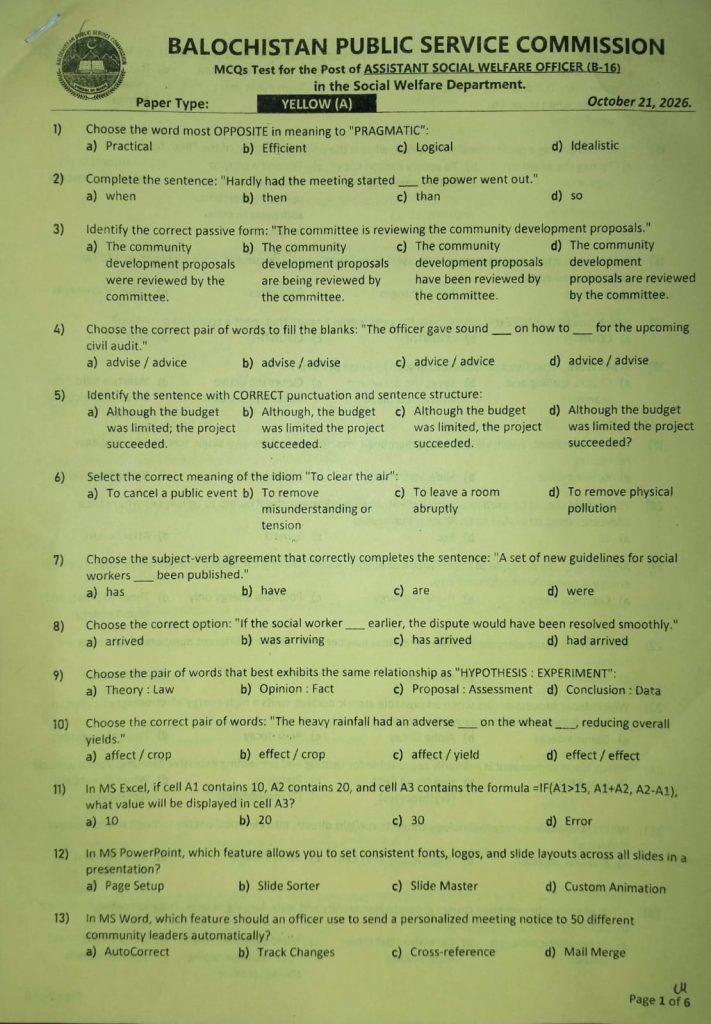
2. English MCQs with answers and explanations (Questions 1–10)
English preparation requires a strong understanding of vocabulary, sentence structure, grammar rules, and common idioms.
1. Opposite of “pragmatic”
- Correct answer: d) Idealistic
- Explanation: Pragmatic means practical and concerned with workable results. Idealistic emphasizes ideals or principles, sometimes without sufficient attention to practical limitations.
2. Complete the sentence: “Hardly had the meeting started ___ the power went out.”
- Correct answer: a) when
- Explanation: The standard construction is “Hardly had … when …”. Remember the related construction “No sooner … than …”.
3. Passive voice of “The committee is reviewing the community development proposals.”
- Correct answer: b) The community development proposals are being reviewed by the committee.
- Explanation: The present continuous tense changes to is/are being + past participle in the passive voice.
4. Advice and advise
- Intended distinction: advice = noun; advise = verb.
- Explanation: Advice is a recommendation, while advise means to recommend. The supplied sentence and answer choices are corrupted: “advise on how to for the upcoming civil audit” is incomplete. The exact intended option cannot be established confidently.
5. Correct punctuation
- Correct answer: c) Although the budget was limited, the project succeeded.
- Explanation: An introductory dependent clause beginning with although is followed by a comma before the main clause.
6. Meaning of “to clear the air”
- Correct answer: b) To remove misunderstanding or tension
- Explanation: The idiom means to discuss a difficult situation openly so that misunderstandings can be resolved.
7. Subject–verb agreement: “A set of new guidelines … been published.”
- Correct answer: a) has
- Explanation: The subject is a set, which is singular. Therefore, the correct construction is “A set of new guidelines has been published.”
8. Third conditional sentence
- Correct answer: d) had arrived
- Explanation: The third conditional describes an unreal past situation: “If the social worker had arrived earlier, the dispute would have been resolved smoothly.”
9. Relationship: “Hypothesis : Experiment”
- Likely intended answer: c) Proposal : Assessment
- Explanation: A hypothesis is examined through an experiment; similarly, a proposal may be examined through an assessment. The analogy is not perfectly precise, so this is the closest available option rather than an indisputable answer.
10. “The heavy rainfall had an adverse ___ on the wheat, reducing overall yields.”
- Correct answer: b) effect/crop
- Explanation: Effect is a noun meaning a result or consequence, while affect is generally a verb. The correct expression is “an adverse effect on the crop.”
3. Computer MCQs with answers and explanations (Questions 11–20)
Computer literacy questions often cover office productivity tools and routine professional communication. Practise these functions directly in Microsoft Office where possible.
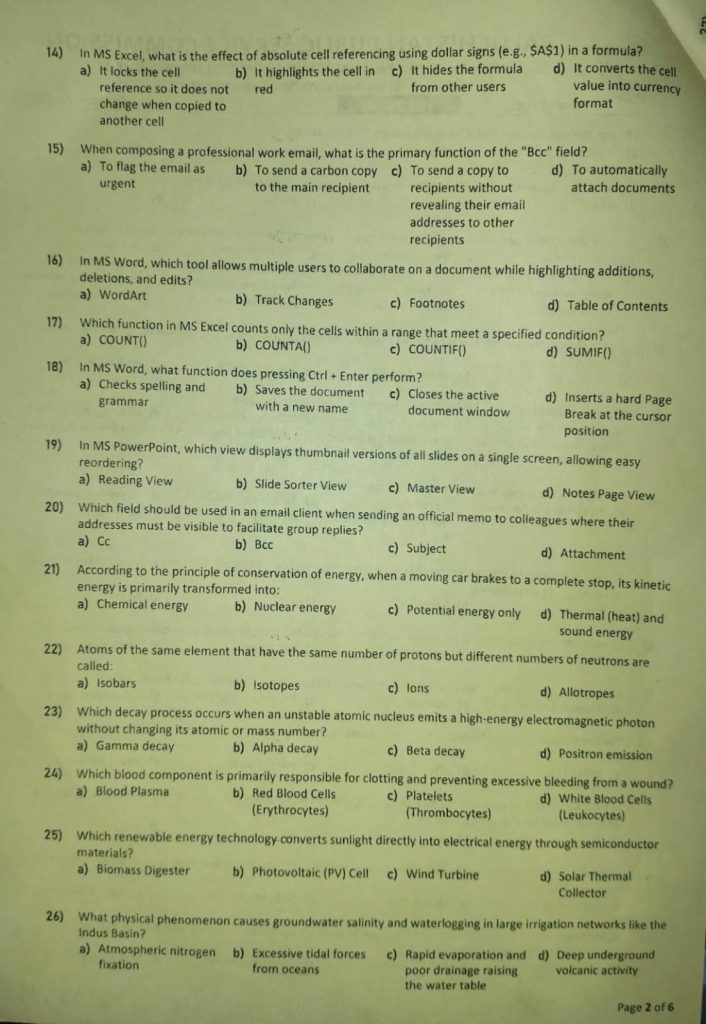
11. Excel IF formula
Given A1 = 10, A2 = 20, and:
=IF(A1>15,A1+A2,A2-A1)
- Correct answer: a) 10
- Explanation: Since 10 is not greater than 15, Excel calculates the third argument: 20 − 10 = 10.
12. Consistent fonts, logos, and layouts in PowerPoint
- Correct answer: c) Slide Master
- Explanation: Slide Master controls shared design elements and layouts across slides.
13. Personalized meeting notices for 50 community leaders
- Correct answer: d) Mail Merge
- Explanation: Mail Merge combines a standard document with a data source containing individual names and other details to create personalized notices.
14. Meaning of absolute cell reference $A$1
- Correct answer: a) It locks the cell reference so it does not change when copied to another cell.
- Explanation: The dollar signs fix both the column and row. By comparison,
$A1fixes only the column, andA$1fixes only the row.
15. Primary function of Bcc in email
- Correct answer: c) To send a copy to recipients without revealing their email addresses to other recipients
- Explanation: Bcc stands for Blind Carbon Copy. Bcc recipients’ addresses are concealed from other recipients.
16. Tracking additions, deletions, and edits in Word
- Correct answer: b) Track Changes
- Explanation: Track Changes records revisions for review. Collaborative editing can also use comments and shared-document features.
17. Excel function that counts cells meeting a condition
- Correct answer: c) COUNTIF()
- Explanation:
COUNTIF(range, criteria)counts cells that satisfy one specified condition.
18. Function of Ctrl + Enter in Word
- Correct answer: d) Inserts a hard page break at the cursor position
- Explanation: A page break forces subsequent content to begin on the next page.
19. PowerPoint view for reordering slides
- Correct answer: b) Slide Sorter View
- Explanation: Slide Sorter displays slide thumbnails together, making it easy to rearrange the presentation.
20. Email field that makes colleagues’ addresses visible
- Correct answer: a) Cc
- Explanation: Cc (Carbon Copy) displays the copied recipients’ addresses to the other recipients. Use Bcc when their addresses should remain concealed.
4. General Science MCQs with answers and explanations (Questions 21–30)
These questions test basic scientific principles and their practical applications in everyday life and the environment.
21. Energy transformation when a moving car stops
- Correct answer: d) Thermal (heat) and sound energy
- Explanation: Braking converts much of the car’s kinetic energy into heat through friction, with some energy transferred into sound and other forms.
22. Atoms with the same number of protons but different numbers of neutrons
- Correct answer: b) Isotopes
- Explanation: Isotopes belong to the same element because they have the same atomic number, but they differ in neutron count and mass number.
23. Emission of a high-energy electromagnetic photon from an unstable nucleus
- Correct answer: a) Gamma decay
- Explanation: Gamma emission releases nuclear energy without changing the atomic number or mass number.
24. Blood component responsible for clotting
- Correct answer: c) Platelets (Thrombocytes)
- Explanation: Platelets help form a plug at an injured blood vessel and support the clotting process.
25. Technology that converts sunlight directly into electricity
- Correct answer: b) Photovoltaic (PV) Cell
- Explanation: Semiconductor materials in photovoltaic cells convert light into electrical energy.
26. Waterlogging and salinity in irrigation systems
- Correct answer: c) Rapid evaporation and poor drainage raising the water table
- Explanation: Excess irrigation, inadequate drainage, and evaporation can contribute to a rising water table and salt accumulation in soil.
27. Effect of increasing light intensity in the photoelectric effect
- Correct answer: a) Number of emitted electrons per second
- Explanation: Above the threshold frequency, higher intensity generally increases the number of emitted electrons. Their maximum kinetic energy depends on the light frequency, not its intensity.
28. Iodine deficiency causing goiter
- Correct answer: b) Endocrine System (Thyroid Gland)
- Explanation: Iodine is required for thyroid hormone production. Deficiency can cause thyroid enlargement, known as goiter.
29. First artificial element synthesized in a laboratory in 1937
- Correct answer: c) Technetium
- Explanation: Technetium is generally recognized as the first element produced artificially. It was identified in 1937.
30. Cause of lunar tidal forces
- Correct answer: d) Differences in gravitational pull exerted on opposite sides of Earth
- Explanation: The Moon’s gravitational attraction differs across Earth, producing tidal forces that contribute to ocean tides.
5. Mathematics MCQs with answers and explanations (Questions 31–40)
Mathematics preparation should focus on algebraic identities, equations, sets, ratios, percentages, and basic numerical operations. In this section, Questions 31–34 require special attention because the supplied text has formatting or transcription problems.
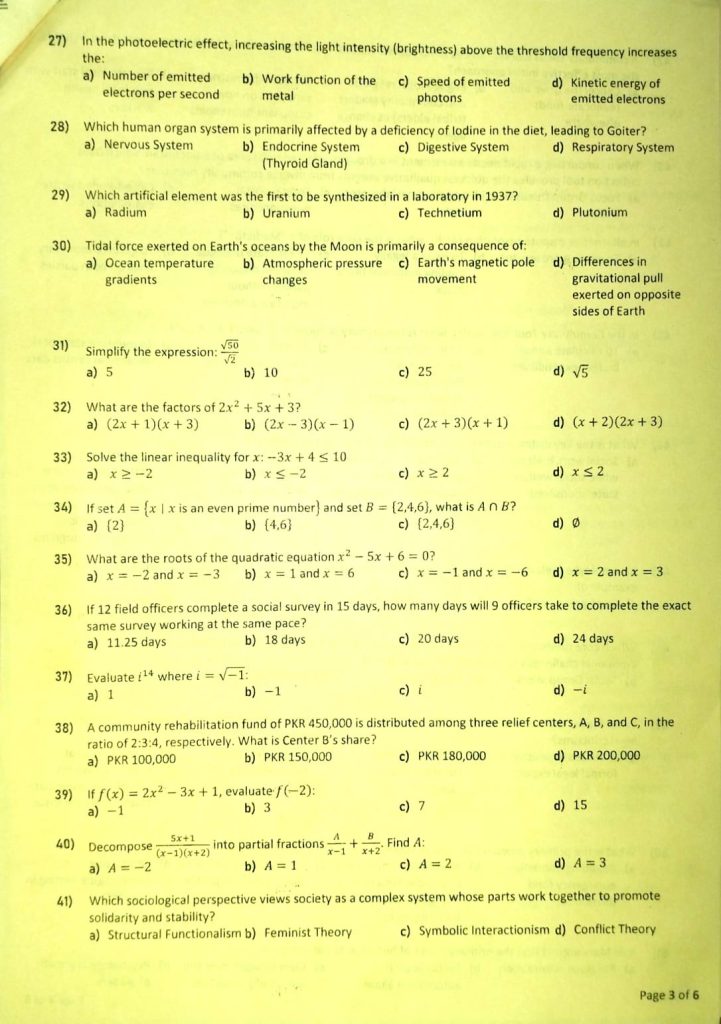
31. Simplify \(\frac{\sqrt{50}}{\sqrt{2}}\)
- Correct answer: a) 5
- Explanation:
\[ \frac{\sqrt{50}}{\sqrt{2}} =\sqrt{\frac{50}{2}} =\sqrt{25}=5 \]
The expression appears separately from the question in the supplied transcription, but this is its correct simplification.
32. Factorise \(2x^2+5x+37\)
- Correct answer: No valid listed option for the expression as written.
- Explanation: None of the four options factorises \(2x^2+5x+37\). If the final number was intended to be 3, the expression would be \(2x^2+5x+3\), which factorises as:
\[ 2x^2+5x+3=(2x+3)(x+1) \]
In that corrected version, option c is correct. Verify the original question before using this as an answer key.
33. Solve the inequality
- Correct answer: Cannot be confirmed from the supplied transcription.
- Explanation: The expression appears as
x / - 3 * x + 4 <= 10, which does not clearly establish the intended mathematical notation. If the intended inequality was \(-3x+4\leq10\), then:
\[ -3x\leq6 \]
Dividing by \(-3\) reverses the inequality:
\[ x\geq-2 \]
Under that interpretation, option a is correct. The original expression must be checked to confirm it.
34. Intersection of sets A and B
Given \(A=\{x\mid x\text{ is an even prime number}\}\) and \(B=\{2,4,6\}\).
- Correct answer: a) \(\{2\}\)
- Explanation: The only even prime number is 2. Therefore, \(A=\{2\}\), and the common elements of A and B are \(\{2\}\). The supplied option formatting is incomplete.
35. Roots of \(x^2-5x+6=0\)
- Correct answer: d) \(x=2\) and \(x=3\)
- Explanation:
\[ x^2-5x+6=(x-2)(x-3)=0 \]
Thus, \(x=2\) or \(x=3\).
36. Work-rate problem: 12 officers complete a survey in 15 days. How long will 9 officers take?
- Correct answer: c) 20 days
- Explanation: Assuming all officers work at the same rate, the total work is \(12\times15=180\) officer-days.
\[ \frac{180}{9}=20\text{ days} \]
37. Evaluate \(i^{14}\), where \(i=\sqrt{-1}\)
- Correct answer: b) \(-1\)
- Explanation: Powers of \(i\) repeat every four powers.
\[ i^{14}=i^{12}i^2=(i^4)^3(-1)=-1 \]
38. Distribute PKR 450,000 in the ratio 2:3:4. What is Center B’s share?
- Correct answer: b) PKR 150,000
- Explanation: Total ratio parts are \(2+3+4=9\). Center B receives three parts.
\[ \frac{3}{9}\times450,000=150,000 \]
39. If \(f(x)=2x^2-3x+1\), calculate \(f(-2)\).
- Correct answer: d) 15
- Explanation:
\[ f(-2)=2(-2)^2-3(-2)+1 \]
\[ =8+6+1=15 \]
40. Partial fractions: Find A in
\[ \frac{5x+1}{(x-1)(x+2)} =\frac{A}{x-1}+\frac{B}{x+2} \]
- Correct answer: c) \(A=2\)
- Explanation: Multiply both sides by \((x-1)(x+2)\):
\[ 5x+1=A(x+2)+B(x-1) \]
Put \(x=1\). Then \(6=3A\), so \(A=2\).
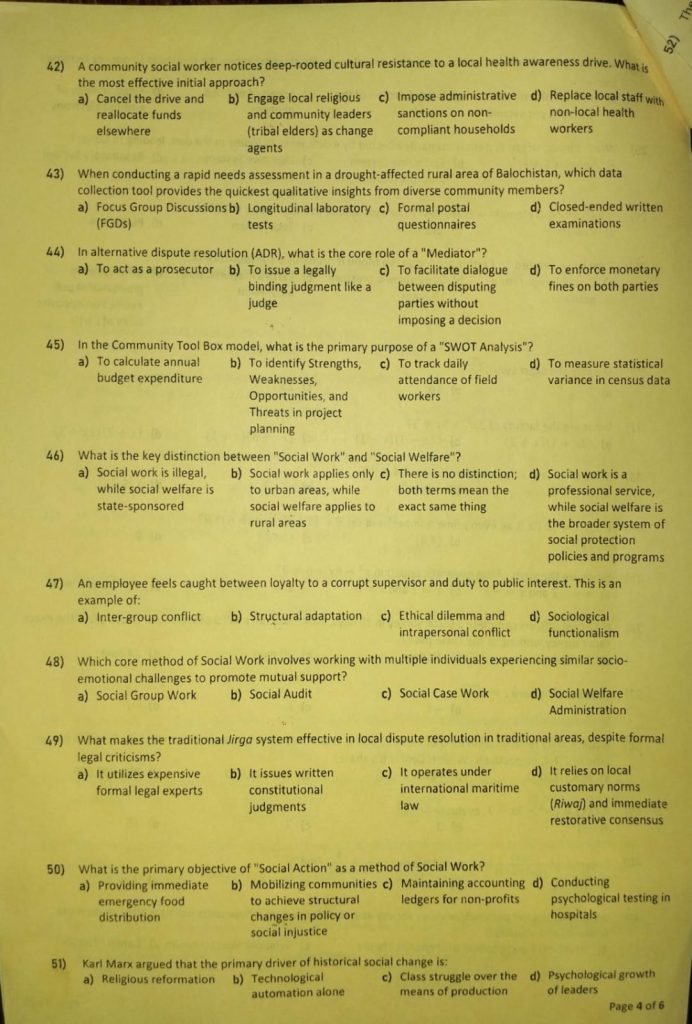
6. Social Work and Sociology MCQs with answers and explanations (Questions 41–70)
This is the largest subject area in the supplied paper. Candidates should concentrate on foundational social work methods, community participation, ethics, sociological theories, poverty measurement, research design, and social welfare programme management.
41. Which sociological perspective views society as a system whose parts work together to maintain stability?
- Correct answer: a) Structural Functionalism
- Explanation: Structural functionalism examines how social institutions and structures contribute to social order, stability, and continuity.
42. How should a social worker initially respond to cultural resistance to a health awareness campaign?
- Correct answer: b) Engage local religious and community leaders as change agents
- Explanation: Trusted local leaders can improve acceptance, help communicate information in culturally appropriate ways, and encourage community participation.
43. Which tool provides rapid qualitative insights during a drought-related needs assessment?
- Correct answer: a) Focus Group Discussions (FGDs)
- Explanation: FGDs gather the views and experiences of several participants through guided discussion. They provide qualitative insights, although they do not replace representative quantitative surveys.
44. Core role of a mediator in alternative dispute resolution
- Correct answer: c) Facilitate dialogue without imposing a decision
- Explanation: A mediator helps disputing parties communicate, explore options, and seek a mutually acceptable settlement. Unlike a judge, a mediator does not ordinarily impose a judgment.
45. Primary purpose of SWOT analysis
- Correct answer: b) Identify Strengths, Weaknesses, Opportunities, and Threats
- Explanation: SWOT analysis helps project planners assess internal strengths and weaknesses alongside external opportunities and threats.
46. Difference between Social Work and Social Welfare
- Correct answer: d) Social work is a professional service, while social welfare is the broader system of social protection policies and programmes
- Explanation: Social Work involves professional methods of helping individuals, families, groups, and communities. Social Welfare includes broader services, programmes, institutions, and policies designed to support people’s well-being.
47. An employee is torn between loyalty to a corrupt supervisor and the public interest. What is this?
- Correct answer: c) Ethical dilemma and intrapersonal conflict
- Explanation: The employee faces competing moral obligations and an internal conflict over the appropriate course of action.
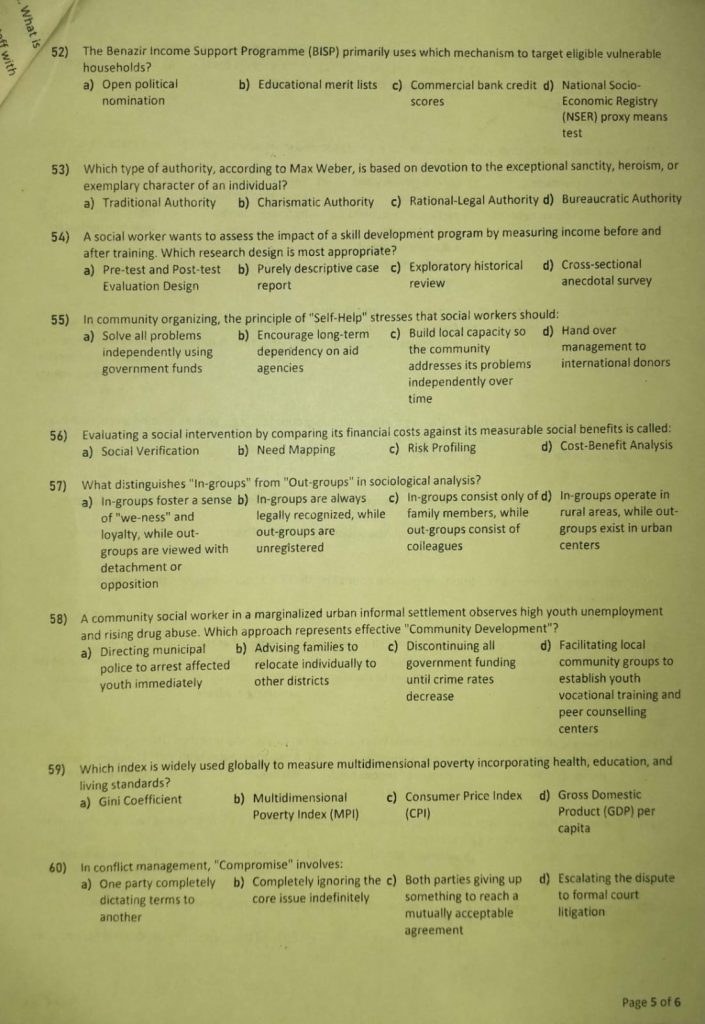
48. Which social work method helps people with similar socio-emotional challenges through group interaction?
- Correct answer: a) Social Group Work
- Explanation: Social Group Work uses group experiences and relationships to promote mutual support, social functioning, personal development, and collective learning.
49. Why can the traditional Jirga system be influential in local dispute resolution?
- Correct answer: d) It relies on local customary norms (Riwaj) and immediate restorative consensus
- Explanation: Local familiarity, customary practices, and community relationships can support informal dispute resolution. However, a customary process must not be assumed to override applicable law or constitutional rights; harmful or coercive practices require particular scrutiny.
50. Primary objective of Social Action as a social work method
- Correct answer: b) Mobilizing communities to achieve structural changes in policy or social injustice
- Explanation: Social Action seeks collective change in institutions, policies, and social conditions that produce injustice or disadvantage. The supplied option contains a formatting error, but this is its apparent intended meaning.
51. According to Karl Marx, the primary driver of historical social change is:
- Correct answer: c) Class struggle over the means of production
- Explanation: Marx’s historical materialist analysis emphasizes conflicts between social classes arising from their relationships to production, property, and economic power.
52. Which mechanism does BISP primarily use to identify eligible vulnerable households?
- Correct answer: d) National Socio-Economic Registry (NSER) proxy means test
- Explanation: The NSER collects household socioeconomic information used in targeting social protection programmes. Proxy means testing estimates household economic status using observable characteristics rather than relying solely on reported income.
53. Max Weber’s authority based on an individual’s exceptional qualities
- Correct answer: b) Charismatic Authority
- Explanation: Charismatic authority rests on followers’ belief in a person’s extraordinary qualities, heroism, or exemplary character.
54. Measuring income before and after a skill development programme
- Correct answer: a) Pre-test and Post-test Evaluation Design
- Explanation: This design compares participants’ outcomes before and after an intervention. A before-and-after comparison alone cannot prove that the programme caused the change; a suitable comparison group can strengthen causal evaluation.
55. Meaning of the Self-Help principle in community organising
- Correct answer: c) Build local capacity so the community can address its problems independently over time
- Explanation: Self-help emphasises community ownership, skill development, participation, and sustainable local capacity rather than permanent dependence on outside agencies.
56. Comparing financial costs with measurable social benefits
- Correct answer: d) Cost-Benefit Analysis
- Explanation: Cost-benefit analysis compares the costs of an intervention with its expected or measured benefits, often expressing both in monetary terms where feasible.
57. Difference between in-groups and out-groups
- Correct answer: a) In-groups foster “we-ness” and loyalty, while out-groups are viewed with detachment or opposition
- Explanation: In-group membership creates a sense of belonging and shared identity. An out-group is perceived as outside that circle of membership.
58. Effective community development response to youth unemployment and drug abuse
- Correct answer: d) Facilitate local groups to establish vocational training and peer counselling centres
- Explanation: Community development encourages local participation and practical solutions that address underlying social and economic problems. Vocational training and peer support may contribute to prevention and rehabilitation when appropriately designed.
59. Index measuring poverty across health, education, and living standards
- Correct answer: b) Multidimensional Poverty Index (MPI)
- Explanation: The MPI considers overlapping deprivations in health, education, and living standards rather than measuring poverty through income alone.
60. Meaning of compromise in conflict management
- Correct answer: c) Both parties give up something to reach a mutually acceptable agreement
- Explanation: Compromise involves concessions by the parties involved. It differs from forcing one side to accept the other side’s terms.
61. Primary use of the Logical Framework Approach (Logframe)
- Correct answer: a) Systematic project design, planning, monitoring, and evaluation
- Explanation: A Logframe organises project objectives, expected results, indicators, verification sources, and assumptions into a structured framework.
62. Why should community development planners understand local Riwaj?
- Correct answer: b) Local legitimacy and participation may depend on culturally accepted norms
- Explanation: Understanding local customs can improve trust, consultation, and project acceptance. Planners must also ensure compliance with applicable law and protect the rights of vulnerable community members.
63. Primary focus of Social Welfare Administration
- Correct answer: d) Transform social policy into operational services and manage agency resources
- Explanation: Social Welfare Administration includes planning, organising, staffing, budgeting, coordinating, supervising, and evaluating social welfare services.
BPSC Staff Nurse Past Paper 2026: 70 MCQs with Answers and Exam Analysis
64. Sampling technique that proportionately represents distinct population subgroups
- Correct answer: d) Stratified Random Sampling
- Explanation: The population is divided into relevant strata, such as age groups or gender categories, and random samples are selected from each. Proportional allocation gives each stratum a sample share corresponding to its population share.
65. Theory that deviance results from society labelling an individual
- Correct answer: c) Labeling Theory
- Explanation: Labeling Theory examines how social reactions and labels can influence identity, treatment, and subsequent behaviour.
66. Term for a condition in which social norms lose their regulatory influence
- Correct answer: a) Anomie
- Explanation: Anomie describes a state of normlessness or weakened normative regulation. It is associated particularly with Émile Durkheim’s sociological work.
67. Meaning of client self-determination in Social Case Work
- Correct answer: c) Help clients make their own decisions by explaining available choices
- Explanation: Social workers support informed decision-making and respect client autonomy, subject to applicable legal, ethical, and safety obligations.
68. When can professional confidentiality be breached?
- Best available answer: b) There is imminent danger of serious harm to the client or others
- Explanation: A serious and imminent risk can justify limited disclosure under applicable law and professional ethics. Other exceptions may also exist, such as valid legal requirements or informed consent, so the word “only” in the question is too absolute.
69. Approach that expands a client’s existing capabilities
- Correct answer: d) Strengths-Based Perspective
- Explanation: The strengths-based approach identifies abilities, resources, resilience, and supportive relationships rather than concentrating exclusively on problems or deficits.
70. When non-material culture lags behind changes in technology
- Correct answer: a) Cultural Lag
- Explanation: Cultural lag occurs when values, norms, institutions, or beliefs adjust more slowly than material culture or technological developments.
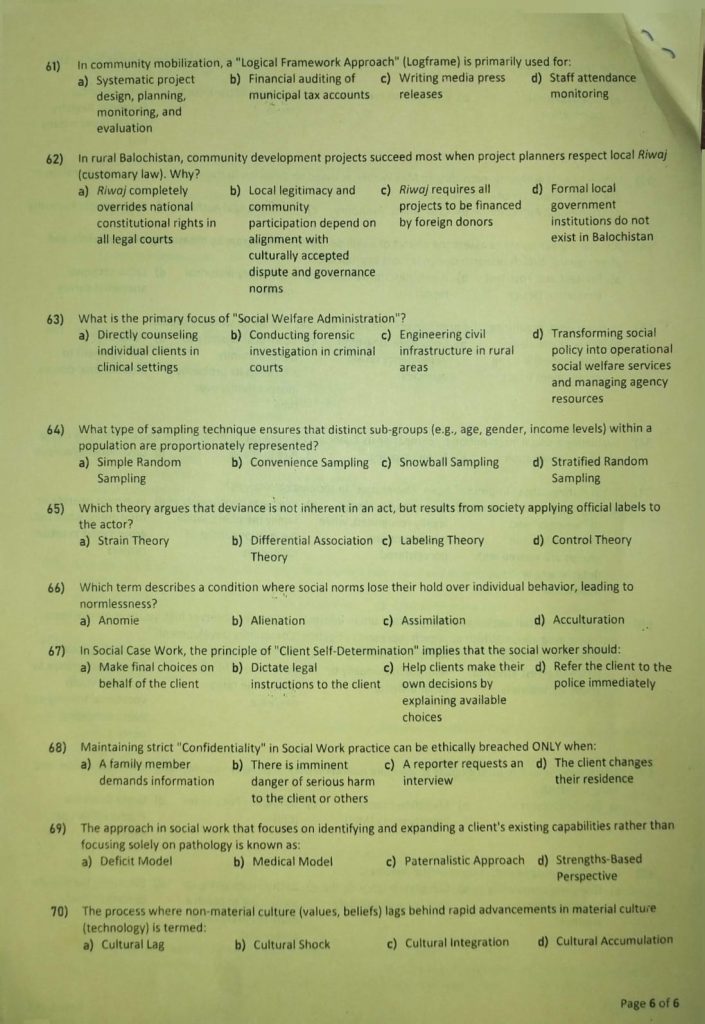
7. Quick answer key for all 70 MCQs
Use this section for rapid revision after studying the explanations above. Questions marked with an asterisk require checking the original paper or interpreting a corrupted transcription.
| Q. | Answer | Q. | Answer |
|---|---|---|---|
| 1 | d | 36 | c |
| 2 | a | 37 | b |
| 3 | b | 38 | b |
| 4 | Ambiguous* | 39 | d |
| 5 | c | 40 | c |
| 6 | b | 41 | a |
| 7 | a | 42 | b |
| 8 | d | 43 | a |
| 9 | c, likely* | 44 | c |
| 10 | b | 45 | b |
| 11 | a | 46 | d |
| 12 | c | 47 | c |
| 13 | d | 48 | a |
| 14 | a | 49 | d |
| 15 | c | 50 | b |
| 16 | b | 51 | c |
| 17 | c | 52 | d |
| 18 | d | 53 | b |
| 19 | b | 54 | a |
| 20 | a | 55 | c |
| 21 | d | 56 | d |
| 22 | b | 57 | a |
| 23 | a | 58 | d |
| 24 | c | 59 | b |
| 25 | b | 60 | c |
| 26 | c | 61 | a |
| 27 | a | 62 | b |
| 28 | b | 63 | d |
| 29 | c | 64 | d |
| 30 | d | 65 | c |
| 31 | a | 66 | a |
| 32 | c, if 37 is a typo for 3* | 67 | c |
| 33 | a, if the inequality is \(-3x+4\leq10\)* | 68 | b, best available* |
| 34 | a, intended \(\{2\}\)* | 69 | d |
| 35 | d | 70 | a |
The answer key follows the wording supplied by the user wherever possible. It should not be represented as an official BPSC key without independent verification.
BPSC Staff Nurse Past Paper 2026: 70 MCQs with Answers and Exam Analysis
8. How to prepare for the upcoming BPSC Assistant Social Welfare Officer exam
Candidates should use the solved paper to identify weak areas, revise core concepts, and practise under timed conditions. Memorising the answer letters alone is unlikely to be sufficient for unfamiliar questions.
Step 1: Prioritise Social Work and Sociology
Revise these high-value concepts from the supplied paper:
- Social Case Work, Social Group Work, and Social Action.
- Community organisation and community development.
- Social Welfare Administration.
- Social research methods and sampling techniques.
- Social work ethics, confidentiality, and self-determination.
- Sociological theories of Karl Marx, Max Weber, and Émile Durkheim.
- Poverty measurement, social protection, and BISP.
- Conflict management, mediation, and local community participation.
Step 2: Practise English and computer MCQs
Review subject–verb agreement, conditional sentences, passive voice, idioms, and vocabulary. In computer studies, practise Excel formulas, absolute references, Mail Merge, Track Changes, Slide Master, and PowerPoint views.
Step 3: Revise mathematics and general science
Practise algebraic factorisation, inequalities, ratios, work-rate problems, set operations, and powers of \(i\). For science, revise basic physics, chemistry, human biology, renewable energy, and environmental problems.
Step 4: Use a timed practice routine
A simple seven-day revision schedule can help organise preparation.
| Day | Main topic |
|---|---|
| 1 | Social Work methods and ethics |
| 2 | Sociology and social theories |
| 3 | Community development and administration |
| 4 | Research methods, poverty, and social protection |
| 5 | English and computer studies |
| 6 | Mathematics and general science |
| 7 | Full MCQ revision and error review |
Adapt this schedule to the official syllabus and the time remaining before your examination.
BPSC Staff Nurse Past Paper 2026: 70 MCQs with Answers and Exam Analysis
9. Frequently asked questions (FAQs)
1. What is the BPSC Assistant Social Welfare Officer past paper 2026?
It is the 70-question paper supplied for the Assistant Social Welfare Officer (B-16) post in the Social Welfare Department, dated October 21, 2026. This article presents a study version with answers and explanations.
2. How many MCQs are included in this solved paper?
The supplied paper contains 70 MCQs across English, computer studies, general science, mathematics, Social Work, and sociology.
3. Are these official BPSC answers?
No. They are proposed answers based on the supplied question text. Several questions contain transcription problems, and the answer key has not been authenticated by BPSC.
4. Which topics should candidates focus on for Social Welfare Officer preparation?
Prioritise Social Work methods, community development, social welfare administration, research methods, sociological theories, social protection, professional ethics, and conflict resolution. Also prepare the general subjects specified in the relevant official syllabus.
5. What is the difference between Social Work and Social Welfare?
Social Work is a professional practice that helps individuals, families, groups, and communities address personal and social challenges. Social Welfare is the broader system of policies, institutions, programmes, and services intended to improve people’s well-being.
6. What is the best way to practise MCQs for BPSC examinations?
Attempt questions without viewing the answers, record incorrect responses, review the underlying concepts, and retake the incorrect questions. Use timed mock tests to improve speed and accuracy.
7. Where can candidates find official BPSC examination information?
Visit the Balochistan Public Service Commission website for official recruitment information and consult the relevant advertisement and syllabus for your post.
8. Does solving one past paper guarantee success in the examination?
No. A past paper helps identify question styles and revision priorities, but it does not guarantee that the same questions or topics will appear again. Candidates should prepare from the official syllabus and use multiple practice resources.
10. Conclusion
The BPSC Assistant Social Welfare Officer (B-16) past paper is a useful revision resource for candidates preparing for Social Welfare Department recruitment examinations in Balochistan. Its questions cover professional Social Work concepts, sociology, community development, research methods, English, computer applications, mathematics, and general science.
Use the explanations to understand why each answer is correct, and verify the flagged mathematics and grammar questions against the original paper before relying on them for memorisation. For upcoming examinations, combine this paper with the official BPSC syllabus, additional MCQ practice, and regular revision.