

Introduction
The Ideology of Pakistan is the foundational concept behind the creation of Pakistan. It reflects the collective vision, beliefs, and aspirations of the Muslims of the Subcontinent who sought a separate homeland to live according to Islamic principles. Understanding the meaning, sources, significance, motives, Two-Nation Theory, and the views of Allama Iqbal and Quaid-e-Azam is essential for students preparing for BPSC, FPSC, PMS, CSS, Lecturer, Headmaster, and other competitive examinations.
This article provides a comprehensive and SEO-optimized explanation of the Ideology of Pakistan, covering all important dimensions in a clear and structured manner.
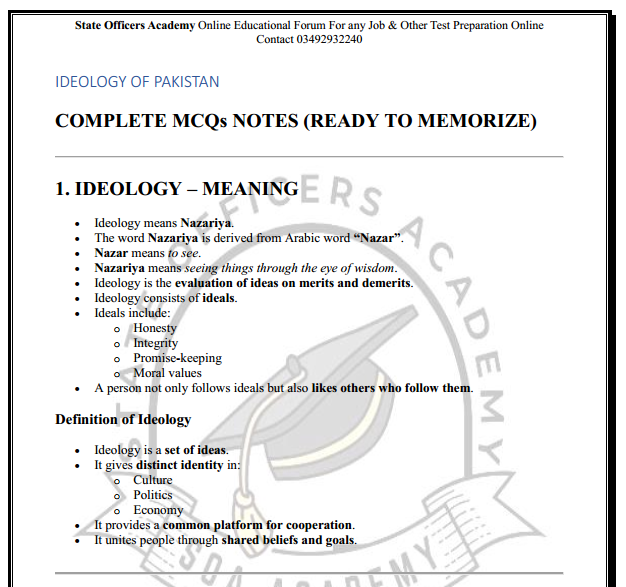
Meaning of Ideology
The word Ideology is known as “Nazariya” in Urdu. The term Nazariya is derived from the Arabic word “Nazar”, which means to see. However, in an intellectual sense, Nazariya means seeing things through the eye of wisdom.
Ideology refers to a systematic set of ideas and beliefs through which individuals or nations evaluate life, society, politics, economy, and culture. It involves judging ideas on the basis of merits and demerits rather than emotions or temporary interests.
The basic components of an ideology are called ideals, such as honesty, integrity, justice, and moral responsibility. These ideals guide both individual and collective behavior.
Definition of Ideology
Ideology is a set of ideas that shapes the distinctive character of a nation in cultural, political, social, and economic fields and provides a common platform for unity and cooperation.
Sources of Ideology
The primary source of ideology is human intellect. Ideologies develop through:
- Human reasoning and wisdom
- Personal experiences
- Deep observation of social surroundings
When the human intellect accepts a truth permanently, it becomes belief or faith. Therefore, faith and ideology are closely related. Ideology can also originate from divine teachings, especially when religion provides a complete code of life, as Islam does.
Significance of Ideology
Ideology plays a vital role in the life of a nation. A strong ideology:
- Creates national unity
- Develops commitment and determination
- Motivates people to struggle for common goals
- Strengthens cultural and intellectual harmony
- Converts people into one nation
Ideology is also a spiritual force that awakens the sense of freedom and resistance against oppression. All major freedom movements, including the Pakistan Movement, were driven by ideological consciousness.
Motives Behind the Ideology of Pakistan
The Muslims of the Subcontinent realized that their religion, culture, social values, and way of life were fundamentally different from those of Hindus. Due to Hindu numerical and political dominance, Muslim religious and political rights were always under threat.
Islam, unlike other religions, is a complete code of life, covering beliefs, worship, social system, politics, economy, and morality. This Islamic system formed the basis of the Ideology of Pakistan.
Islamic Beliefs (Foundation of Ideology of Pakistan)
The creation of Pakistan was aimed at enabling Muslims to live according to Islamic beliefs, which include:
- Tauheed (Oneness of Allah)
- Faith in Prophets, especially Hazrat Muhammad ﷺ as the last Prophet
- Faith in Angels
- Faith in Holy Books
- Faith in the Day of Resurrection
These beliefs demand complete obedience to Allah according to the Quran and Sunnah, which was not possible in a united Hindu-dominated India.
Islamic Way of Life
Worship
Islamic worship includes:
- Namaz
- Roza
- Zakat
- Hajj
These acts require a supportive Islamic social and administrative environment.
Religious Festivals
Muslims celebrate Eid-ul-Fitr and Eid-ul-Azha, while Hindus celebrate festivals such as Diwali, highlighting cultural and religious differences.
Social Equality and Human Rights in Islam
Islam strongly rejects racial discrimination and caste system. All human beings are equal, and superiority is based only on piety (Taqwa). This principle was clearly stated by the Holy Prophet ﷺ in his Last Sermon.
Islam also guarantees:
- Right to life, property, and honor
- Freedom of faith and expression
- Protection of minority rights
Quaid-e-Azam emphasized that minorities in Pakistan would enjoy complete religious freedom.
Democratic Values, Law, and Justice
In an Islamic state:
- Sovereignty belongs to Allah Almighty
- Laws must be framed according to Quran and Sunnah
- Governance is based on Shura (mutual consultation)
Islam ensures rule of law and justice, declaring that no individual is above the law. Without justice, no society can progress.
Economic Exploitation of Muslims
During British rule, Muslims faced severe economic exploitation:
- Limited job opportunities
- Backward Muslim-majority areas
- Interest-based economic system
An Islamic economic system free from exploitation was another major motive behind Pakistan’s creation.
Background of the Two-Nation Theory
The Two-Nation Theory states that Muslims and Hindus are two separate nations due to differences in religion, culture, civilization, and ideology.
Even after British withdrawal, Hindu majority rule would have marginalized Muslims. Therefore, a separate homeland was the only solution.
Role of Sir Syed Ahmad Khan
Sir Syed Ahmad Khan was the first to present the Two-Nation Theory practically. He warned Muslims against the undemocratic attitude of the Congress and emphasized Muslim political identity.
Ideology of Pakistan in Allama Iqbal’s View
Allama Muhammad Iqbal explained the Two-Nation Theory philosophically through poetry. In his Allahabad Address (1930), he demanded a separate Muslim state in:
- Punjab
- Sindh
- NWFP
- Balochistan
- Kashmir
Iqbal rejected nationalism based on race or language and declared religion as the only basis of nationhood.
Ideology of Pakistan in Quaid-e-Azam’s View
Quaid-e-Azam Muhammad Ali Jinnah explained the Ideology of Pakistan politically. He clearly stated that:
- Muslims are a separate nation
- Islam is a complete code of life
- Pakistan was created to establish an Islamic system
He rejected both British imperialism and Hindu domination, emphasizing freedom, justice, and Islamic principles.
Conclusion
The Ideology of Pakistan is deeply rooted in Islamic faith, values, and civilization. It provided the intellectual and moral foundation for the Pakistan Movement and continues to guide the country’s constitutional, social, and political framework. Understanding this ideology is not only essential for examinations but also for preserving Pakistan’s national identity.

