

Pakistan is a country rich in cultural diversity, historical depth, and strong social values. Its society and culture are shaped by religion, traditions, regional identities, and a shared national consciousness. Understanding the society and culture of Pakistan is essential for students, competitive exam candidates, and anyone interested in Pakistani studies.
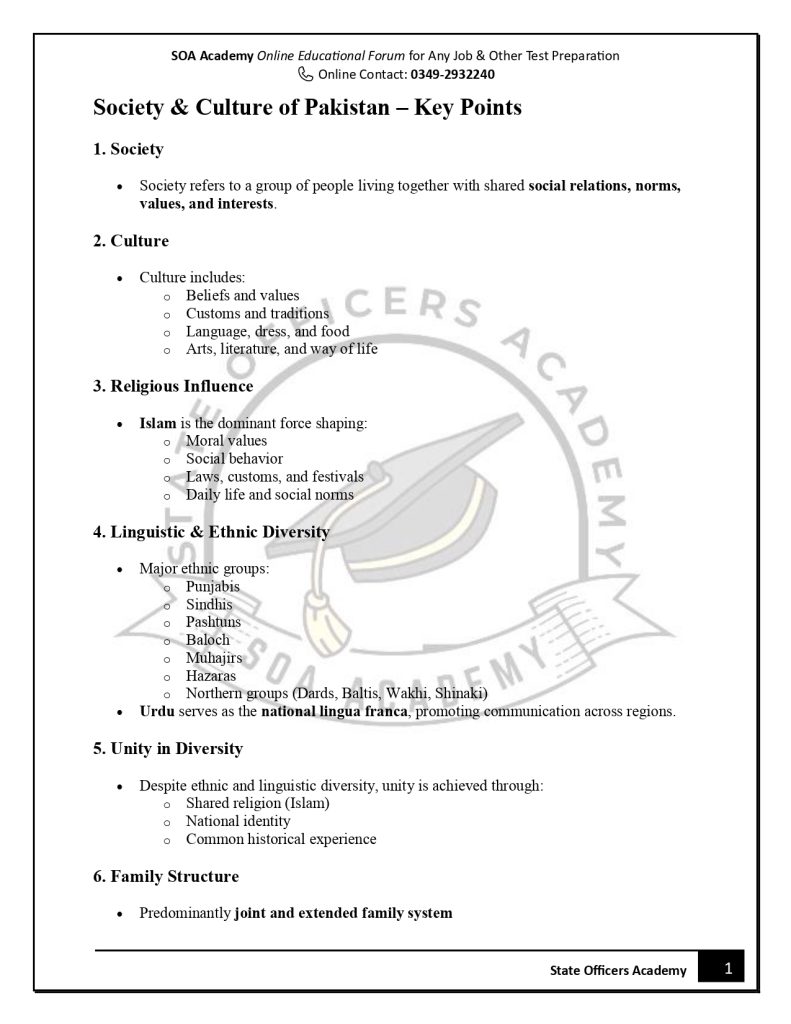
What Is Society?
A society is a group of people who live together in an organized manner and share common:
- Social relationships
- Norms and values
- Customs and traditions
- Collective interests
In Pakistan, society is community-oriented, emphasizing cooperation, mutual respect, and social responsibility rather than extreme individualism.
Meaning of Culture
Culture refers to the complete way of life of a people. In Pakistan, culture includes:
- Beliefs and moral values
- Customs and traditions
- Language and literature
- Dress and cuisine
- Arts, architecture, and handicrafts
Culture is transmitted from one generation to another mainly through family and community practices.
Religious Influence on Pakistani Society
Islam is the central force shaping Pakistani society and culture. It influences:
- Moral values and ethics
- Social behavior and norms
- Family life
- Laws and customs
- Festivals and celebrations
Islamic teachings promote justice, equality, respect for elders, hospitality, and social harmony, which are deeply rooted in Pakistani culture.
Linguistic and Ethnic Diversity
Pakistan is a multi-ethnic and multilingual country. Major ethnic groups include:
- Punjabis
- Sindhis
- Pashtuns
- Baloch
- Muhajirs
- Hazaras
- Northern communities such as Dards, Baltis, Wakhi, and Shinaki
Despite this diversity, Urdu serves as the national language and lingua franca, enabling communication across different regions.
Unity in Diversity
One of the defining features of Pakistan is unity in diversity. Although people differ in language, dress, and regional customs, they are united by:
- Islam
- National identity
- Shared history and struggle
This unity strengthens social cohesion and national integration.
Family System in Pakistan
The joint and extended family system is a cornerstone of Pakistani society. Key characteristics include:
- Strong family bonds
- Respect for elders
- Collective decision-making
- Mutual support among relatives
The family plays a vital role in socialization and moral development.
Patriarchal Nature of Society
Traditionally, Pakistani society is patriarchal, where:
- Men are considered heads of families
- Major decisions are often male-dominated
However, with education and social change, the role of women is gradually expanding in education, employment, and public life.
Social Institutions
Several social institutions shape Pakistani society:
- Family – primary source of socialization
- Religion – moral and ethical guidance
- Education system – knowledge and civic values
- Media – awareness and cultural expression
These institutions collectively influence attitudes, behavior, and social norms.
Cultural Heritage of Pakistan
Pakistan’s cultural heritage is a blend of Islamic and regional traditions, influenced by:
- South Asian civilizations
- Central Asian cultures
- Middle Eastern traditions
This heritage is visible in architecture, literature, music, and traditional crafts.
Traditions and Festivals
Religious festivals play a significant role in social life. Major festivals include:
- Eid-ul-Fitr
- Eid-ul-Adha
These occasions promote:
- Social unity
- Charity and compassion
- Community bonding
Dress and Cuisine
Traditional Dress
- Shalwar Kameez is the most widely worn dress across Pakistan.
- Regional variations add cultural richness.
Pakistani Cuisine
- Reflects regional diversity
- Follows Islamic dietary laws
- Known for rich flavors and traditional cooking methods
Arts and Handicrafts
Pakistan has a rich tradition of arts and crafts, including:
- Folk music and regional dance
- Architecture (mosques, shrines, historical buildings)
- Embroidery, pottery, and handicrafts
These cultural expressions reflect regional identities and historical influences.
Importance of Understanding Society and Culture
Studying the society and culture of Pakistan helps to:
- Strengthen national identity
- Promote tolerance and harmony
- Prepare for competitive exams and interviews
- Preserve cultural heritage
Conclusion
The society and culture of Pakistan represent a unique combination of Islamic values, regional diversity, and historical influences. Despite ethnic and linguistic differences, Pakistan remains united through shared religion, traditions, and national identity. This cultural richness continues to shape the social fabric of the country and plays a vital role in its development.

Appreciated
Hi there everyone, it’s my first go to see at this web site, and post is
actually fruitful in favor of me, keep up posting such articles.