

Artificial Intelligence has moved beyond simple chatbots and image generators. In 2026, the biggest new AI trend reshaping industries is Agentic AI — autonomous AI systems capable of reasoning, planning, and executing complex tasks with minimal human supervision.

From enterprise automation to personal AI assistants, this new generation of AI is redefining productivity, business operations, software development, healthcare, finance, and even creativity. Companies worldwide are investing billions into intelligent AI agents that can act independently instead of merely responding to prompts.
The AI landscape is evolving faster than ever, and organizations that fail to adapt risk falling behind in an increasingly AI-driven economy.
In this article, we will explore:
- What the new AI trend actually is
- Why Agentic AI is gaining massive attention
- Key AI technologies powering the shift
- Industries being disrupted
- Challenges and risks
- Future predictions for AI in 2026 and beyond
What Is the New AI Trend?
The biggest AI trend in 2026 is the rise of Agentic AI systems — AI that can think, plan, make decisions, use tools, and complete workflows autonomously.
Traditional AI systems required constant prompts and human direction. Modern AI agents can now:
- Analyze goals
- Break tasks into subtasks
- Use external tools
- Access databases
- Communicate with other AI agents
- Adapt strategies dynamically
- Complete long-term objectives
This represents a major shift from “AI that answers questions” to “AI that performs actions.”
According to recent enterprise AI research, agentic systems are moving rapidly from experimentation into real-world deployment across healthcare, finance, retail, logistics, and software engineering.
Why Agentic AI Is Exploding in Popularity
Several technological breakthroughs converged to create this AI revolution.
1. Large Language Models Became More Powerful
Modern LLMs can now:
- Understand context better
- Process multimodal inputs
- Maintain memory
- Perform reasoning
- Execute long workflows
Instead of generating isolated responses, AI systems can sustain entire operational chains.
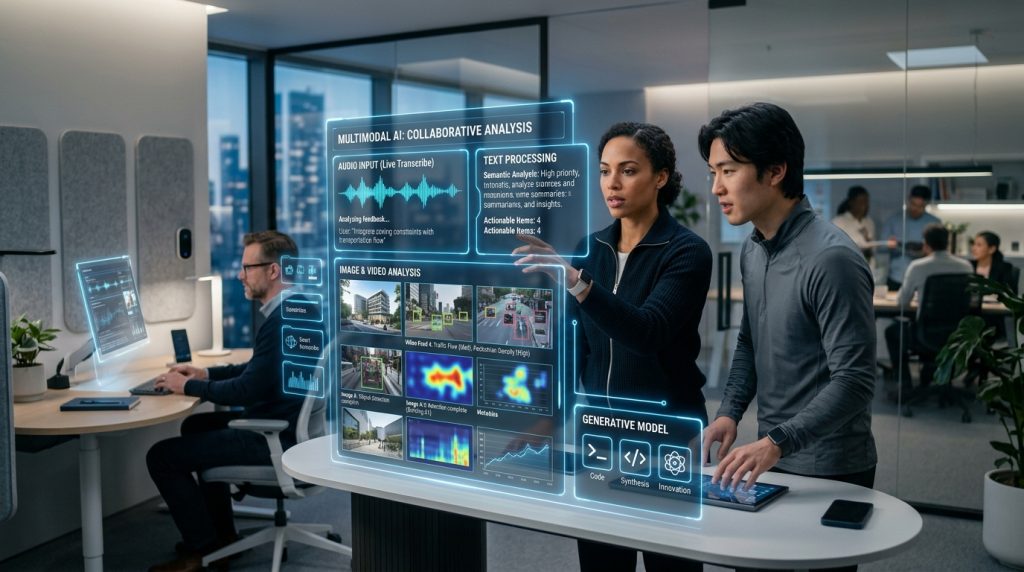
2. Multimodal AI Changed User Interaction
AI is no longer limited to text.
Modern AI models can simultaneously process:
- Text
- Images
- Audio
- Video
- Code
- Documents
- Voice commands
This allows AI agents to function more like humans.
For example:
- A marketing AI can analyze videos, create captions, generate campaigns, and schedule posts.
- A healthcare AI can read scans, process patient notes, and recommend treatments.
- A coding agent can debug software while documenting fixes automatically.
Multimodal capability is now considered one of the defining AI trends of 2026.
3. Enterprises Want ROI From AI
Businesses are no longer impressed by AI demos alone.
Companies now demand:
- Productivity gains
- Workflow automation
- Cost reduction
- Faster operations
- Measurable ROI
This has accelerated investment into task-specific AI agents.
Research shows many enterprises are shifting from pilot programs toward production-grade AI systems integrated directly into CRM, ERP, and operational software stacks.
What Makes Agentic AI Different?
Traditional generative AI responds to prompts.
Agentic AI pursues objectives.
That distinction changes everything.
Traditional AI Example
User prompt:
“Write a sales email.”
AI generates email.
Task ends.
Agentic AI Example
User objective:
“Increase B2B sales pipeline by 20%.”
AI agent may:
- Analyze CRM data
- Identify high-conversion leads
- Draft personalized outreach
- Schedule follow-ups
- Monitor engagement
- Generate performance reports
- Recommend strategy adjustments
The AI operates continuously toward a goal.
This transition from reactive systems to proactive systems is the defining characteristic of the new AI era.
Top AI Trends Emerging Alongside Agentic AI
Agentic AI is the central trend, but several related technologies are accelerating its adoption.

1. Multi-Agent AI Systems
Instead of one giant AI model handling everything, companies now deploy teams of specialized AI agents.
Examples include:
- Research agents
- Coding agents
- Security agents
- Customer support agents
- Data analysis agents
These systems collaborate similarly to human teams.
Industry experts identify multi-agent orchestration as one of the fastest-growing enterprise AI architectures.
2. Small Language Models (SLMs)
While large AI models dominate headlines, smaller optimized models are becoming increasingly important.
Benefits include:
- Lower cost
- Faster performance
- Better privacy
- Local device deployment
- Reduced energy consumption
SLMs allow AI to run directly on laptops, phones, and edge devices.
This trend is particularly important for:
- Healthcare
- Banking
- Government systems
- Defense
- Offline enterprise environments
Many enterprises now prefer fine-tuned smaller models over expensive massive LLMs.
3. AI Copilots in the Workplace
AI copilots are becoming integrated into daily workflows.
Modern enterprise copilots can:
- Summarize meetings
- Write reports
- Analyze spreadsheets
- Generate code
- Draft presentations
- Automate customer responses
Major enterprise deployments now involve hundreds of thousands of employees using AI copilots daily.
This signals a broader shift where AI becomes part of the standard digital workplace infrastructure.
4. AI Automation for Business Operations
Businesses increasingly use AI to automate repetitive workflows.
Examples include:
- Invoice processing
- HR onboarding
- Customer service
- Legal document review
- Fraud detection
- Financial analysis
The automation economy is becoming AI-first.
Companies that previously automated workflows with rules-based software are now upgrading to intelligent AI-driven orchestration.
5. AI + Robotics Integration
Physical AI is another major emerging trend.
AI agents are increasingly connected to:
- Industrial robots
- Warehouses
- drones
- autonomous vehicles
- smart factories
This creates systems capable of autonomous physical decision-making.
Manufacturing and logistics sectors are aggressively investing in this area.
Industries Being Transformed by the New AI Trend
Healthcare
AI is revolutionizing healthcare through:
- Faster diagnostics
- Drug discovery
- Patient monitoring
- Medical imaging analysis
- Personalized treatment recommendations
Agentic systems can assist doctors by continuously analyzing patient data in real time.
Finance
Banks and fintech firms use AI for:
- Fraud detection
- Trading analysis
- Customer support
- Compliance automation
- Risk assessment
AI agents can monitor thousands of transactions simultaneously and respond instantly to anomalies.
Software Development
Coding AI agents are transforming software engineering.
Modern development agents can:
- Generate code
- Debug applications
- Write documentation
- Run tests
- Optimize performance
This dramatically accelerates software delivery cycles.
Retail and E-Commerce
Retail AI systems now handle:
- Product recommendations
- Dynamic pricing
- Customer support
- Inventory forecasting
- Personalized marketing
Hyper-personalization has become a competitive advantage.
Education
AI tutors are becoming increasingly sophisticated.
Modern educational AI can:
- Personalize learning
- Adapt lessons dynamically
- Evaluate student progress
- Provide 24/7 tutoring
This could democratize high-quality education globally.
The Rise of AI Infrastructure
AI adoption is also reshaping global infrastructure.
Massive investments are flowing into:
- AI data centers
- GPU clusters
- cloud computing
- edge AI devices
- AI networking systems
Companies like NVIDIA, Microsoft, Google, Meta, and OpenAI are competing aggressively to dominate the AI infrastructure layer.
Recent announcements show the growing importance of hardware specifically optimized for agentic AI workloads.
AI Governance and Regulation Are Becoming Critical
As AI becomes more autonomous, governments are increasing regulation efforts.
Major concerns include:
- Privacy
- Bias
- Deepfakes
- Job displacement
- AI-generated misinformation
- Cybersecurity risks
- Autonomous decision-making
The EU AI Act and emerging global regulations are pushing organizations toward stronger AI governance frameworks.
Companies now need:
- AI compliance systems
- Human oversight
- Risk auditing
- Transparent decision processes
- Ethical AI policies
Governance is becoming a core requirement for enterprise AI deployment.
Biggest Challenges Facing AI in 2026
Despite rapid growth, AI still faces major obstacles.
1. Hallucinations and Reliability Issues
AI systems can still generate inaccurate or misleading information.
For enterprise adoption, reliability remains one of the biggest barriers.
Research highlights a “verification gap” where organizations struggle to trust fully autonomous systems without human oversight.
2. High Infrastructure Costs
Advanced AI systems require enormous computing power.
Challenges include:
- GPU shortages
- Rising cloud costs
- energy consumption
- scalability limitations
Many organizations now prioritize smaller optimized models to reduce costs.
3. Security Risks
AI agents interacting with tools and systems introduce new attack surfaces.
Potential risks include:
- Prompt injection
- Data leaks
- Unauthorized actions
- Automated cyberattacks
AI cybersecurity is becoming an industry of its own.
4. Job Displacement Concerns
Automation may significantly reshape labor markets.
Jobs involving repetitive digital tasks face the highest disruption risk.
However, many experts believe AI will also create entirely new industries and roles focused on:
- AI supervision
- AI operations
- Prompt engineering
- AI governance
- AI safety
- Human-AI collaboration
The Future of AI: What Happens Next?
The future of AI appears to be moving toward:
- Autonomous digital workers
- AI-native operating systems
- Personalized AI assistants
- Human-AI collaboration ecosystems
- Always-on enterprise automation
Experts predict AI will increasingly disappear into the background infrastructure of everyday software.
Instead of opening separate AI apps, users will interact with AI embedded directly into:
- Email platforms
- business software
- smartphones
- operating systems
- productivity tools
AI becomes invisible but omnipresent.
Will AI Replace Humans?
This remains one of the most debated questions.
The more realistic scenario is augmentation rather than total replacement.
AI excels at:
- Pattern recognition
- Repetitive workflows
- data processing
- automation
Humans still dominate in:
- Creativity
- Ethics
- leadership
- emotional intelligence
- strategic judgment
The future workforce will likely combine human expertise with AI-powered productivity.
Organizations that learn effective human-AI collaboration will gain the biggest competitive advantage.
Why Businesses Must Adapt Now
Companies delaying AI adoption face growing competitive pressure.
AI-first organizations can:
- Operate faster
- Reduce costs
- Improve customer experiences
- Scale operations efficiently
- Make smarter decisions
The gap between AI leaders and laggards is widening rapidly.
Enterprise AI adoption is no longer optional — it is becoming foundational infrastructure for modern business.
Final Thoughts
The new AI trend of 2026 is not just better chatbots or smarter search engines.
It is the emergence of autonomous, multimodal, agentic AI systems capable of executing real-world tasks independently.
This marks a historic shift in how humans interact with technology.
AI is transitioning from:
- Tool → Assistant → Autonomous Collaborator
Businesses, developers, creators, and professionals who understand this shift early will be positioned to thrive in the next wave of digital transformation.
The AI revolution is no longer coming.
It is already happening.

