

Many people search for passive income from Etsy because they want an online income source that can continue generating sales without exchanging every hour of work for one dollar. The basic idea is appealing: create a product once, publish it in an Etsy shop, and allow future customers to purchase it while you focus on other responsibilities, a job, or a side business.
However, passive income does not mean effortless income.
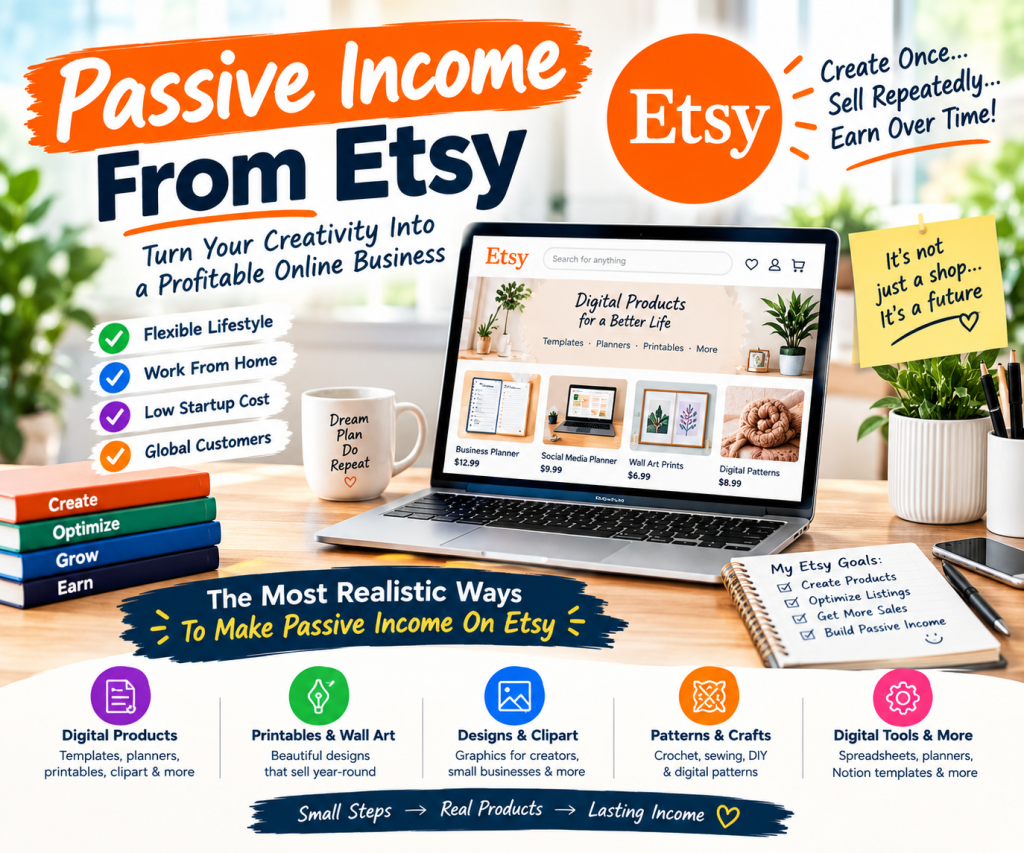
Etsy can provide semi-passive income, but it is not a guaranteed money machine. Building a successful shop requires upfront work and regular maintenance. You may spend time researching customer demand, creating useful products, preparing strong listings, improving Etsy SEO, answering questions, and reviewing sales data. Even an established shop may need updates when trends, customer expectations, or Etsy policies change.
The most realistic Etsy income model is:
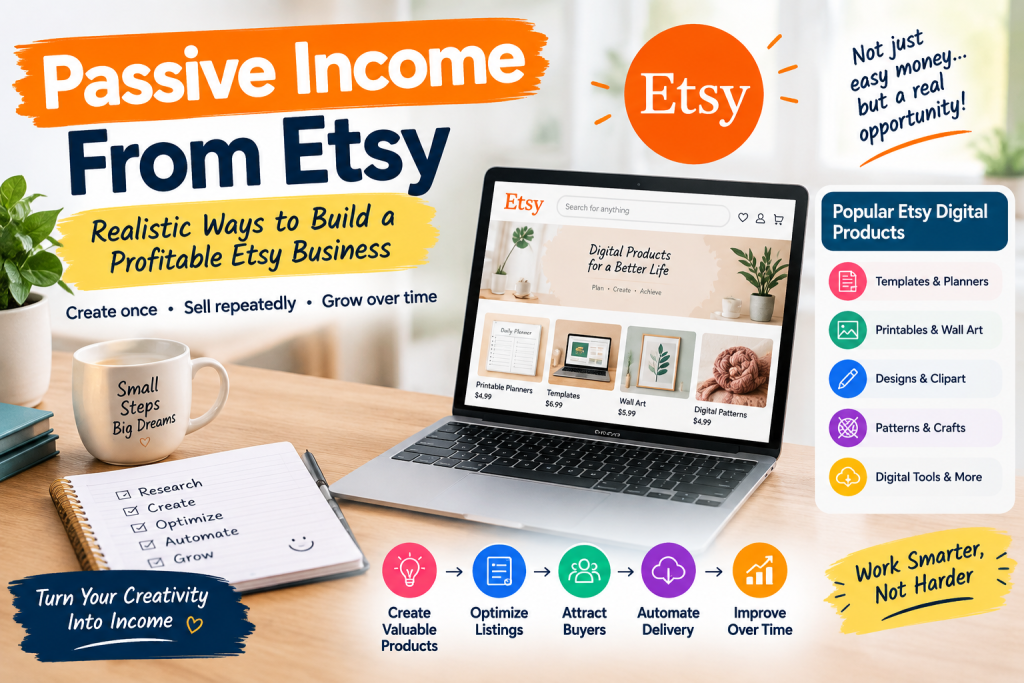
Create valuable products → optimize listings → attract buyers → automate delivery → improve over time.
This model works best when each product solves a clear problem or serves a specific audience. Digital files can sometimes continue producing results months or even years after publication, but those results are possible rather than guaranteed. Etsy is a marketplace, so search visibility, competition, reviews, customer service, and demand all influence performance.
Digital products are especially attractive because Etsy may automatically deliver eligible files after purchase. Sellers can offer templates, printable designs, patterns, planners, clipart, and other downloadable products without packaging or shipping. Even so, sellers remain responsible for accurate files, permitted intellectual property, customer support, refunds, taxes, and compliance with Etsy’s current policies. Revenue is not the same as profit after transaction fees, software, advertising, taxes, and other business costs.
This guide explains practical ways to build passive income from Etsy, what beginners can do from home, which product models may reduce fulfillment work, and how to get started with realistic expectations. The goal is not instant money, but a sustainable Etsy business that improves through consistent work, testing, and customer-focused decisions.
What Does Passive Income From Etsy Really Mean?
The term “passive income” is often misunderstood. In the context of an Etsy shop, it usually means income that can continue after the main creative work is complete, not money earned without any effort.
True passive income is rarely completely hands-off. Most online business models require upfront work, occasional maintenance, customer support, and decisions about pricing, promotion, and product updates. That is why passive income Etsy strategies are more accurately described as semi-passive income.
Etsy income is better described as semi-passive income.
For example:
A seller spends about two weeks creating and testing a premium crochet pattern. The work may include researching demand, writing instructions, taking photographs, preparing files, and checking that the finished product is easy for customers to use.
They upload it to Etsy with:
- professional images
- SEO-friendly title
- detailed description
- relevant tags
- customer instructions
After that, Etsy handles important parts of the transaction through its marketplace platform, including:
- payment processing
- automatic file delivery
- order notifications
This automation reduces repetitive work, but it does not remove the seller’s responsibilities. The seller may still need to:
- answer customer questions
- update products
- create new designs
- improve rankings
Digital products may also require file revisions, backup copies, copyright checks, and clear usage instructions. Sellers should review their listings regularly, monitor customer feedback, and use permitted tools to identify problems. Passive income Etsy results depend on maintaining a useful catalog, not simply publishing one file and leaving it untouched.
But the seller does not need to recreate the same product every time someone buys it. After the initial work, one listing can potentially generate multiple sales while requiring less time per order than a handmade item.
That is what makes Etsy attractive.
A physical handmade product usually requires:
- buying materials
- creating each item
- packaging
- shipping
A digital Etsy product can be created once and sold repeatedly, although income is never guaranteed. This model can reduce inventory, delivery, and shipping work, giving sellers more flexibility to build a business around digital products.
The Most Realistic Ways To Make Passive Income On Etsy
There are several Etsy business models, but some are much closer to passive income than others. The best options usually reduce repetitive fulfillment work while still requiring thoughtful research, original creation, customer support, and occasional updates.
The strongest opportunities usually come from products that can be created once and sold repeatedly. Before investing significant time, validate each idea by reviewing Etsy search results, studying competing listings, identifying an underserved customer need, and checking whether buyers show consistent demand. A small minimum viable product can help you test an idea before developing a larger collection of new products.
1. Selling Digital Downloads on Etsy
Digital products are one of the most realistic ways to build passive income etsy because there is no physical inventory and, in many cases, no shipping. After the initial design and listing work, one file can potentially create multiple sales with less time spent on each order.
Etsy supports digital listings where customers can receive eligible downloadable files after purchase. These products include artwork, patterns, templates, and many other creative files.
Examples of potentially profitable digital products include printable products, digital art, business templates, craft files, and educational resources. Profit depends on demand, originality, pricing, licensing, file quality, and the ability of a shop to attract the right buyers. Check Etsy’s current file requirements and make sure every font, image, graphic, and design has the necessary commercial rights.
Printable Products
Printable products are files customers download and print themselves. A strong printable does more than look attractive: it helps a specific buyer organize, plan, learn, celebrate, or solve a practical problem. Consider offering clearly labeled PDF files, appropriate page sizes, printing instructions, and previews that show exactly what the buyer will receive.
Examples:
- planners
- calendars
- budget sheets
- wedding invitations
- classroom worksheets
- meal planners
- habit trackers
- coloring pages
A good printable solves a specific problem. When evaluating an idea, search Etsy using the words a buyer would type, compare prices and reviews, and read questions or complaints on competing listings. This research can reveal missing sizes, accessibility needs, language options, or personalization opportunities.
A generic planner may struggle because thousands already exist. Specificity can improve relevance, but it does not guarantee Etsy ranking or sales. Your product still needs a useful format, clear instructions, attractive images, and a price that reflects its value.
A targeted product has better potential:
Instead of:
“Daily Planner”
Create:
“Small Business Owner Weekly Planner”
or
“Wedding Budget Planner Spreadsheet”
The more specific the buyer need, the easier it becomes to attract customers who already understand why they need the item. You can also test related ideas, such as a large-print planner, a screen-friendly version, or a bundle for a particular profession. These variations should improve usability rather than merely duplicate existing listings.
Digital Art and Wall Decor
Many Etsy buyers purchase artwork they can print at home. Digital art can support passive income when the files are professionally prepared, clearly licensed, and offered in formats that work for common home-printing needs. Include high-resolution files, multiple aspect ratios when appropriate, color guidance, and mockups that show the art in a realistic room.
Examples:
- nursery wall art
- motivational posters
- vintage artwork
- seasonal decorations
- holiday prints
The key is understanding customer intent. A buyer may want coordinated nursery decor, a specific color palette, a gift for a hobby, or seasonal art that fits a particular room. Research the audience, not only the visual style, and avoid using copyrighted characters, protected logos, or vintage images without verified rights.
People do not usually search for “beautiful image.”
They search for:
- “boho nursery wall art”
- “Halloween printable decor”
- “Christmas farmhouse sign”
SEO-focused product creation matters. Use relevant keywords naturally in the title, tags, description, and attributes, while keeping the copy readable. Seasonal demand can create sales opportunities, but prepare listings before the season begins and do not treat temporary results as proof of permanent success.
Templates
Templates are another strong category because buyers want to save time. They can help job seekers, creators, families, and businesses complete a task faster. A template should be easy to edit, compatible with the promised software, and accompanied by concise instructions or a guide.
Examples:
- resume templates
- Canva templates
- business cards
- social media templates
- presentation templates
- invoice templates
Businesses may pay more for templates because they provide practical value and save work. However, review the current commercial-use terms for Canva, stock assets, fonts, and any tools used to create the files. Test the customer experience yourself, show the editable areas in the images, explain what is included, and price the product according to its usefulness rather than its file size.
2. Selling Crochet Patterns and Craft Patterns
Craft patterns are one of the clearest examples of semi-passive Etsy income. A seller creates the instructions once, then can potentially sell the digital file repeatedly instead of producing a finished handmade item for every order.
Instead of selling a finished handmade product, sellers create instructions that customers use to make the product themselves. The pattern must be accurate, complete, and easy to follow for the stated skill level. Include materials, measurements, abbreviations, gauge information when relevant, step-by-step photographs, and troubleshooting notes.
Examples:
- crochet patterns
- knitting patterns
- sewing patterns
- embroidery patterns
- amigurumi designs
A successful pattern can continue selling for years, but sales depend on seasonal interest, search visibility, quality, and customer satisfaction. Do not assume that one popular pattern will generate hundreds or thousands of sales; describe those outcomes as possible exceptions, not normal results.
For example:
A seller creates a Halloween crochet character pattern.
They spend time creating:
- written instructions
- step-by-step images
- stitch counts
- materials list
- final product photos
After uploading, customers worldwide may be able to purchase the PDF, subject to Etsy’s current digital-product rules. The seller should test the download, keep a backup, answer reasonable questions, and correct errors when customers identify them.
The same file can generate repeat sales without requiring the seller to make every finished item. The number of sales will vary widely by niche, demand, pricing, reviews, and marketing.
The advantage is that the seller does not need to make every finished item, which can make this product model a practical way to build a catalog of digital products and long-term Etsy income.
3. Etsy Print on Demand
Print-on-demand (POD) is another popular Etsy income method and a possible way to build passive income etsy with less inventory management. You create original designs, publish product listings, and use a production partner to make and ship each item after a customer places an order. This reduces fulfillment work, but it does not eliminate customer service, marketing, or business management.
With POD, sellers create designs that are printed on products such as:
- shirts
- mugs
- hoodies
- posters
- phone cases
When a customer orders:
- Customer purchases from Etsy.
- A printing company creates the product.
- The company ships it to the customer.
The seller does not store inventory, but the seller remains responsible for selecting a reliable production partner and accurately describing the item. Before promoting a product, order samples to check print quality, sizing, materials, packaging, and delivery times. Etsy may also require sellers to disclose production partners, so review the platform’s current rules before publishing the listing.
Calculate profit before choosing a price. Subtract the base product cost, Etsy and payment-processing fees, shipping, discounts, advertising, refunds, taxes, and other tools from the selling price. A product that generates sales may still lose money if its margin is too small. Set realistic delivery estimates and communicate delays promptly.
However, POD is not completely passive.
Challenges include:
- high competition
- lower profit margins
- customer service issues
- quality control
Successful POD sellers usually focus on:
- specific niches
- original designs
- strong branding
- seasonal trends
A random shirt design usually has little chance because it gives buyers no clear reason to choose it.
A targeted design has a better opportunity when it matches a specific audience, search intent, and demand. Never rely on trademarked phrases, copyrighted characters, logos, or copied designs. Confirm that every element in your artwork has commercial-use permission.
Examples:
Instead of:
“Funny Shirt”
Create:
“Teacher Halloween Coffee Shirt”
or
“Retro Camping Shirt For Outdoor Lovers”
4. Selling SVG and Cutting Files
SVG files are popular among people who use cutting machines for crafts. These digital products can support passive income because buyers download the file and create physical products themselves, but the file must be tested carefully before you offer it for sale.
Customers use these files with machines to create:
- shirts
- stickers
- mugs
- signs
- decorations
Popular SVG categories:
- holiday designs
- family themes
- professions
- hobbies
- seasonal events
Examples:
- Christmas SVG bundles
- Teacher SVG collections
- Halloween cutting files
- Wedding SVG designs
Organize files by format, include a test image or assembly guide, explain compatibility with common cutting-machine software, and state whether buyers receive personal or commercial-use rights. Bundles may attract buyers because they offer more variety, but they do not automatically perform better; relevance, originality, quality, and clear instructions determine results.
🎨 Create Your Professional Email Signature Today
Make every email look more professional with a polished and clickable email signature.
With 24 professional HTML email signature designs, an easy-to-use generator, Gmail and Outlook support, a detailed PDF guide, and a step-by-step video tutorial, you have everything you need to create your signature.
✨ No complicated coding. No designing from scratch. Just enter your information, choose your favorite design, copy, and install.
👉 Get the 24 Professional Email Signature Templates on Etsy
Start creating your professional email signature today!
5. Create Product Bundles
One useful strategy for Etsy passive income is increasing the value of each listing without creating an entirely separate customer journey. A bundle can combine related products, solve a broader problem, and increase average order value, although it will not automatically increase conversion rate or sales.
Instead of selling:
One design for $3
Create:
50 design bundle for $15
Customers may prefer bundles when the contents are relevant and the savings are clear. Show the included products in the images, name the file formats, explain the license, and compare the bundle price with the individual-product price.
Examples:
Instead of:
“5 Halloween PNG Files”
Create:
“100 Halloween PNG Bundle For Shirts And Crafts”
Bundles can increase:
- average order value
- customer satisfaction
- search visibility
6. Build a Large Product Catalog
One difference between struggling Etsy shops and successful shops can be the number and quality of relevant listings. More listings create more opportunities to test ideas and reach buyers, but catalog size is not a guarantee of success.
A shop with five products has limited opportunities.
A shop with:
- 50 products
- 100 products
- 300 products
has more chances to appear in search results when those listings target relevant keywords and customer needs.
Think of every listing as a salesperson working for your business.
One product may sell occasionally.
But hundreds of optimized products create more opportunities to learn which categories, designs, and price points attract demand.
However, quantity should not replace quality. Review performance, improve weak images and descriptions, remove inaccurate products, and expand only the ideas that serve a clear audience.
Uploading hundreds of poor products will not create success and may make a shop harder to manage.
How Much Money Can You Realistically Make From Etsy?
Income varies significantly from one Etsy shop to another. The figures below are illustrative ranges, not guarantees or official Etsy benchmarks. Your results may depend on your product category, price, conversion rate, seasonality, customer demand, traffic source, operating costs, and the amount of time you invest.
Some beginners may make:
- $50–$200 per month
Some growing shops may reach:
- $500–$3,000 per month
Established sellers with strong catalogs may earn:
- several thousand dollars monthly
These amounts should be treated as gross sales unless the seller specifically states otherwise. Net income is what remains after Etsy fees, payment processing, materials or production costs, shipping, advertising, software, refunds, and taxes. A simple calculation is: net income = sales revenue − business expenses − taxes. For example, a $20 sale does not equal $20 of profit if fees, delivery costs, and other expenses reduce the final amount.
But results depend on:
- product quality
- niche selection
- SEO
- competition
- number of listings
- customer reviews
- marketing
A realistic expectation:
First 3 months:
- learning
- testing products
- improving listings
During this stage, focus on learning how buyers search, testing a small group of products, and improving the quality of your product listings. Do not judge the entire business by a few early sales or by one listing that receives little traffic.
3–12 months:
- building catalog
- gaining reviews
- finding winning products
Use performance data to identify which products attract visits, favorites, and sales. Improve promising listings before creating many new products, and track profit rather than revenue alone.
12+ months:
- scaling successful categories
Etsy rewards consistency more than quick experiments. If you want passive income etsy, begin with one well-researched listing, monitor its results, and improve the title, images, description, price, and customer experience before expanding the shop.
🎨 Create Your Professional Email Signature Today
Make every email look more professional with a polished and clickable email signature.
With 24 professional HTML email signature designs, an easy-to-use generator, Gmail and Outlook support, a detailed PDF guide, and a step-by-step video tutorial, you have everything you need to create your signature.
✨ No complicated coding. No designing from scratch. Just enter your information, choose your favorite design, copy, and install.
👉 Get the 24 Professional Email Signature Templates on Etsy
Start creating your professional email signature today!
Etsy SEO: The Key To Long-Term Passive Sales
Creating a product is only half the work. Customers need to find it, understand its value, and feel confident enough to buy it. Etsy SEO can improve the chance that relevant buyers discover your products, but SEO cannot compensate for weak quality, inaccurate descriptions, poor images, or an unsatisfactory customer experience.
Etsy works like a search engine. Buyers type keywords, and Etsy uses listing information and other signals to determine which products may appear. Search visibility can change, so treat SEO as an ongoing process rather than a one-time task.
A practical Etsy SEO workflow is to collect the language buyers use, compare relevant competing listings, select one primary search phrase, write a clear title, add closely related tags and attributes, improve the images, and monitor results over time. Use permitted SEO tools to organize keyword ideas, but write for people instead of forcing phrases into every sentence.
Important SEO areas include:
Product Title
Your title should include buyer search terms and clearly identify the product. Put the most important phrase near the beginning when it reads naturally, then explain the format, audience, or main use. Follow Etsy’s current title guidance and character limits rather than relying on outdated advice.
Weak:
“Cute Design”
Better:
“Halloween Crochet Basket Pattern PDF, Amigurumi Treat Bag Tutorial”
Tags
Tags help Etsy understand your product. Use specific, relevant keywords that reflect different ways customers might describe the same item. Avoid keyword stuffing, repeated wording that adds no meaning, and tags that do not accurately match the listing.
Examples:
- crochet pattern
- halloween basket
- amigurumi pdf
- digital download
Description
Your description should clearly explain:
- what the buyer receives
- product benefits
- usage information
- important details
Good descriptions improve buyer confidence. Before expanding your business, create and optimize one test listing, review its search impressions and customer response, and use the results to guide your next update or marketing decision.
Common Mistakes That Prevent Etsy Passive Income
Many beginners struggle with passive income because they expect fast results from a new Etsy shop. A sustainable business usually requires research, testing, accurate listings, customer care, and consistent improvement before sales become predictable.
Mistake 1: Choosing Products Without Research
Creating products you personally like is not enough. Before developing an item, check whether buyers actively search for it and whether the market offers room for a useful, differentiated product. Personal interest can help you stay motivated, but customer demand should guide the business decision.
You need to understand:
- customer demand
- competition
- pricing
- search behavior
Review Etsy search suggestions, competing listings, customer reviews, and buyer questions. Permitted tools like keyword research software can help organize ideas, but search volume alone does not prove that a product will generate sales. Compare the likely price with production costs, Etsy fees, taxes, and the time needed to create and support the product. Start with a small test listing, then use its traffic and customer response to decide whether to improve, expand, or abandon the idea.
Mistake 2: Copying Successful Shops
Competition research is useful. It can show how other sellers present an item, explain its benefits, structure their listings, and serve a particular audience.
Copying another seller’s exact product, wording, images, or designs is not. Copyright, trademark, and other intellectual-property rules may protect a seller’s work, and Etsy can take action against infringing listings. Treat competitor research as a way to identify unmet customer needs, not as a shortcut to duplicate someone else’s success.
Successful sellers study:
- presentation
- keywords
- customer needs
Then create something original. Add a distinct use case, improve the instructions, serve a narrower audience, or develop original designs that reflect your own expertise. Do not use trademarked phrases, copyrighted characters, logos, or another shop’s photos without verified permission.
Mistake 3: Poor Images
Etsy is highly visual, so customers often form an initial impression from the thumbnail before reading the full listing. Clear images cannot guarantee sales, but confusing, low-quality, or inaccurate images can make buyers leave before they understand the product.
Professional images should show:
- product quality
- details
- benefits
- examples
Use a readable thumbnail, consistent branding, and images that show scale, dimensions, colors, file formats, and what the customer will receive. For physical products, include detail shots and lifestyle examples. For digital products, mockups are extremely important, but label them clearly so buyers do not mistake a preview image for a physical item. Add accessible text where appropriate and make sure every image matches the listing description.
Mistake 4: Uploading Only a Few Products
Many sellers quit after uploading 5–10 products. That number is not a universal threshold for success, and a shop does not need to publish hundreds of weak listings to create passive income.
A serious Etsy business usually requires testing many ideas. Begin with a manageable group of related products, track impressions, visits, favorites, conversion rate, sales, and profit, and improve the listings that attract qualified buyers. Expand the catalog when the data supports it, while keeping quality, relevance, and customer experience ahead of volume.
🎨 Create Your Professional Email Signature Today
Make every email look more professional with a polished and clickable email signature.
With 24 professional HTML email signature designs, an easy-to-use generator, Gmail and Outlook support, a detailed PDF guide, and a step-by-step video tutorial, you have everything you need to create your signature.
✨ No complicated coding. No designing from scratch. Just enter your information, choose your favorite design, copy, and install.
👉 Get the 24 Professional Email Signature Templates on Etsy
Start creating your professional email signature today!
A Realistic 12-Month Etsy Passive Income Plan
Months 1–3: Foundation
Use the first three months to build a reliable foundation for your Etsy shop rather than expecting immediate passive income. Set aside a realistic amount of time each week, such as five to ten focused hours, and treat the process as a learning stage for your business.
Focus on:
- choosing a niche
- researching competitors
- creating first products
- learning Etsy SEO
Research customer demand, review competing shops, define your ideal buyers, and choose products you can create consistently. Prepare accurate files, original artwork, pricing, shop policies, customer instructions, and product images before publishing. Use Etsy’s current guidance and permitted tools to research keywords, but confirm that every design and asset is legally available for commercial use.
Goal:
20–50 quality listings. This is an optional benchmark, not an Etsy requirement or a guarantee of income. A lower-budget beginner can start with fewer listings, reuse a consistent workflow, and invest time in improving each product before expanding.
Months 4–6: Optimization
After collecting enough data, review impressions, visits, favorites, conversion rate, sales, refunds, customer questions, and net profit. These results show whether a listing needs better presentation, a clearer offer, a different price, or a new audience.
Improve:
- thumbnails
- titles
- descriptions
- pricing
Create more products based on successful ideas. Revise a listing when it receives views but few purchases, test a variation when buyers show a specific unmet need, and discontinue an idea when repeated improvements fail to attract relevant traffic. Build a bundle when several related products appeal to the same customer.
Goal:
50–100 listings. Treat this range as an optional planning target. Quality, relevance, customer satisfaction, and profitable sales matter more than the number of listings.
Months 7–12: Scaling
Once your shop has reliable data, scale the parts of the business that produce healthy income etsy results. Continue allocating time to customer support, file updates, policy reviews, and marketing instead of assuming that passive income is completely automatic.
Focus on:
- bundles
- seasonal products
- customer reviews
- expanding winning categories
Earn reviews by delivering the product accurately and providing helpful customer service; never pressure buyers to leave feedback in a way that conflicts with Etsy policy. Before you scale, confirm your files, pricing, shop policies, support process, Etsy SEO, licenses, and intellectual-property rights.
Goal:
100+ optimized listings, if the catalog remains manageable and profitable. This step can support passive income etsy over time, but the platform, demand, and customer behavior can change. Track net income and update your plan instead of treating the target as a promise.
Final Thoughts
Passive income from Etsy is possible, but it requires a realistic mindset. Etsy income is usually semi-passive rather than fully passive: the initial work can continue producing results, while the shop still needs customer support, updates, marketing, and policy checks.
The sellers who achieve long-term success usually do not rely on one lucky product or one sudden wave of sales.
They build a digital asset library of useful, original products and improve it as customer demand, search behavior, and the platform change.
A successful Etsy shop is similar to building a small online business:
- products are assets
- listings are marketing pages
- SEO brings traffic
- customer reviews build trust
The most realistic paths include:
- digital downloads
- crochet and craft patterns
- templates
- printables
- SVG files
- print-on-demand designs
The biggest advantage of Etsy is that your effort can continue producing results after the initial work is complete. A well-made item may generate additional sales without requiring you to recreate it for every customer, although income is never guaranteed.
Creating one product may not change your income. Creating more valuable products can create more opportunities, but dozens or hundreds of listings do not automatically create profit. Quality, relevance, demand, pricing, customer experience, and net margins matter more than volume.
To get started, choose one product category and validate one customer need. Create one high-quality listing, confirm that your files and designs are original or properly licensed, calculate net income after fees and taxes, and establish a monthly review schedule. Use the results to improve the listing or develop related ideas.
The goal is not instant money. The goal is building a catalog of products that may create a sustainable income stream over time. Follow this guide as a practical way to build passive income etsy while supporting customers, following Etsy policies, and adapting your business to changing buyers and market conditions.


The framing of Etsy income as semi-passive rather than truly passive is the most honest part of this piece. I’d push further on one point: the article mentions maintenance when trends or policies change, but doesn’t address how much ongoing customer support digital downloads actually require. Refund requests, file access issues, and customization questions can quietly consume hours. For anyone planning a 12-month timeline, how would you suggest budgeting that recurring support time so it doesn’t erode the semi-passive benefit?