

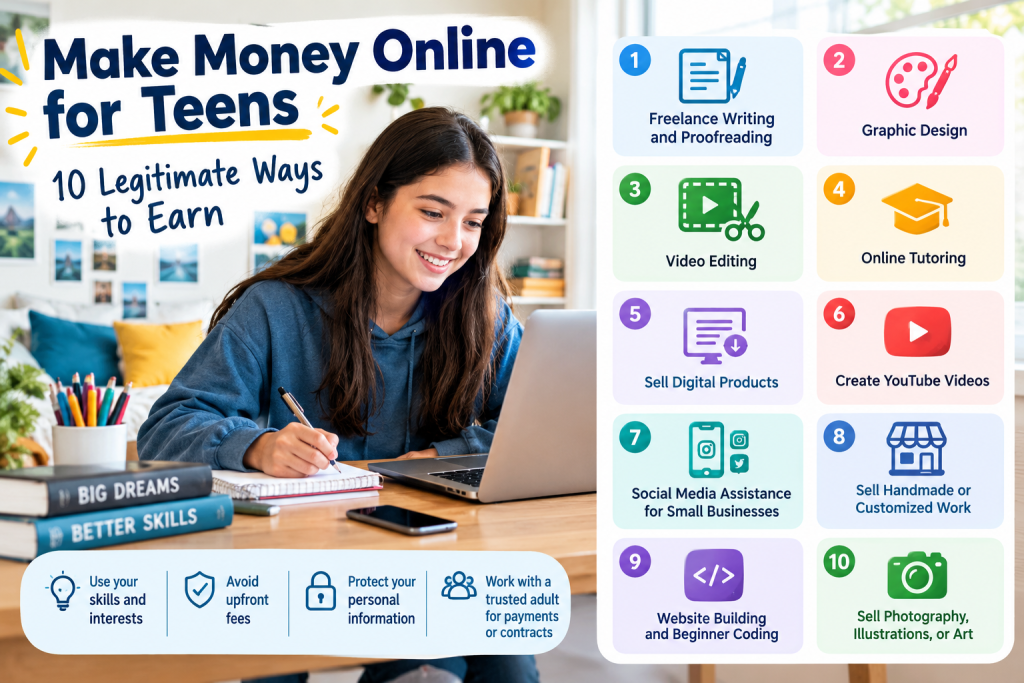
Make money online for teens: Teens can make money online by tutoring younger students, designing graphics, editing videos, selling digital products with appropriate adult supervision, or creating educational content. The best option depends on a teenager’s skills, age, available time, and the rules of the platform. Start with a useful service, avoid upfront fees, protect personal information, and involve a trusted adult when payments or contracts are involved.

Make Money Online by Surveys: A Complete Guide for US Beginners
1. Freelance writing and proofreading
If you enjoy writing, offer services such as proofreading school newsletters, editing short articles, writing product descriptions, or drafting blog posts for small businesses.
Build a portfolio with three to five original samples. For example, create a short blog article, a product description, and a sample newsletter. These demonstrate your abilities without requiring previous clients.
You can find potential customers through family connections, community organizations, school networks, or small businesses that accept young freelancers. Do not misrepresent your age on freelance platforms.
Best for: Teens who enjoy writing, grammar, and research.
2. Graphic design
Graphic design is a practical online earning option for teens who enjoy visual creativity. Potential services include:
- Social media graphics
- YouTube thumbnails
- Event posters
- Simple presentation designs
- Flyers for local businesses
- Basic brand assets
Start with a free or low-cost design tool and build a small portfolio of original work. Show how your designs solve a client’s problem rather than simply displaying random examples.
Avoid using copyrighted logos, photographs, fonts, or illustrations without appropriate permission.
Best for: Creative teens who want to develop a portfolio and learn design fundamentals.
3. Video editing
Creators and small businesses often need help turning raw footage into short, clear videos. Teens who understand editing software can learn to trim clips, add captions, improve pacing, and format videos for different social platforms.
A useful starter portfolio might include:
- A 20-second educational video
- A captioned interview clip
- A short product demonstration
- A before-and-after editing example
Use footage you own or have permission to edit. Do not publish a client’s private footage in your portfolio without consent.
Best for: Teens interested in YouTube, short-form video, storytelling, and digital media.
4. Online tutoring
Tutoring can turn a subject you understand well into a service that helps other students. Possible subjects include mathematics, English, science, beginner coding, and language practice.
Begin with a narrow offer, such as helping middle-school students understand fractions or practice basic grammar. Prepare sample lessons and explain your service to parents, teachers, or community groups.
For minors, arrange sessions with parental awareness, use appropriate communication channels, and follow school or platform rules. Avoid doing another student’s graded work for them; focus on explaining concepts and helping them learn.
The US Department of Labor identifies tutoring and teaching among the types of work that may be permitted for 14- and 15-year-olds, subject to applicable rules.
Best for: Teens who communicate clearly and perform well in particular subjects.
Make Money Online by Surveys: A Complete Guide for US Beginners
5. Sell digital products
Digital products can include original study planners, printable checklists, flashcards, revision templates, digital artwork, and presentation templates.
The main benefit is that a file can be sold repeatedly without shipping a physical item. The limitation is that creating a product does not guarantee sales: demand, quality, pricing, competition, and promotion all matter.
A simple process is:
- Choose one specific audience, such as high-school students preparing for exams.
- Identify a problem, such as organizing revision sessions.
- Create an original printable study planner.
- Ask potential users for feedback.
- Improve the product before trying to sell it.
- Track expenses, sales, and customer questions.
Platform warning: Etsy allows users aged 13–17 to participate only with permission and direct supervision from a parent or legal guardian who owns the account. The adult must provide the required account and financial information and remains responsible for account activity.
Official policy: Etsy’s minors policy
6. Create YouTube videos
YouTube can help teens build communication, editing, research, and audience-development skills. Potential topics include tutorials, book discussions, beginner coding, study techniques, art demonstrations, and educational explainers.
Start with a manageable publishing schedule and prioritize content that provides genuine value. Use original footage, licensed media, or material you have permission to use.
Do not assume that views automatically translate into income. Monetization requires meeting YouTube’s eligibility criteria and complying with its policies.
Age requirement: Google states that AdSense applicants must be at least 18. If a creator is under 18, monetization can be handled through an approved AdSense for YouTube account belonging to a parent or guardian who is over 18, subject to the applicable requirements.
Official guidance: YouTube monetization for creators under 18
Best for: Teens willing to develop a skill and audience over time rather than expecting immediate earnings.
7. Social media assistance for small businesses
Some small businesses need help creating post graphics, organizing content calendars, drafting captions, or resizing images for different platforms.
A teenager with these skills can prepare a sample content calendar and show a local business what a week’s worth of content could look like.
Start with a clearly defined service, such as designing five promotional graphics or preparing a basic monthly posting plan. Agree on deliverables, deadlines, payment, revisions, and ownership before beginning work.
Do not promise viral reach or guaranteed sales. Explain what you will deliver, not results you cannot control.
Best for: Teens who understand social media design and organization.
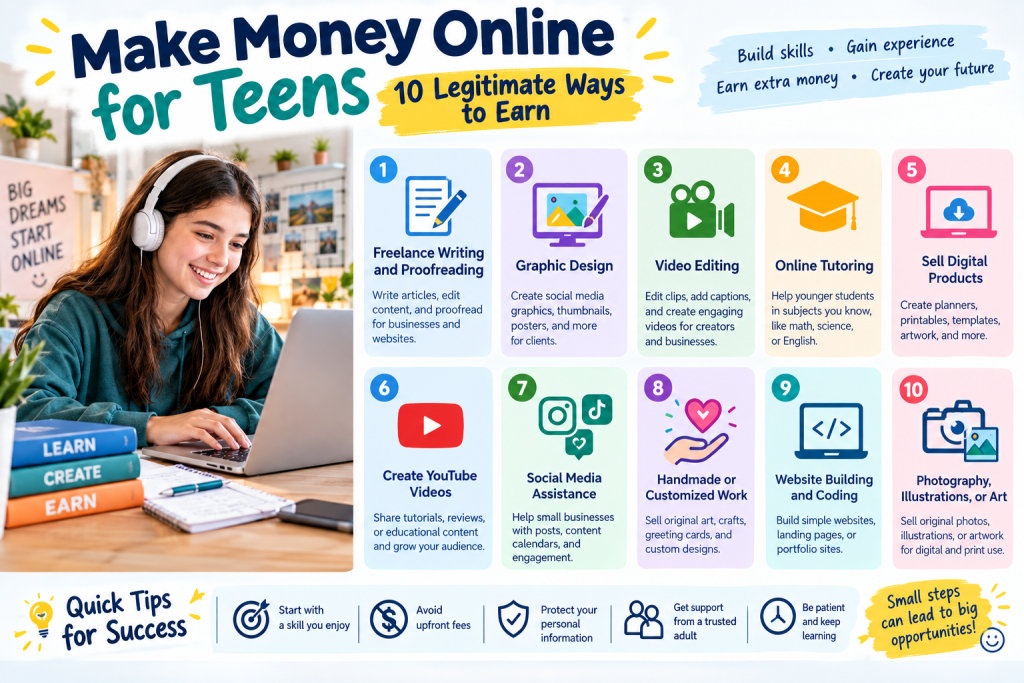
8. Sell handmade or customized creative work online
If you make illustrations, greeting cards, custom artwork, craft patterns, or other original creations, online selling may provide a way to reach customers beyond your local area.
Begin by testing interest with a small collection instead of investing heavily in supplies. Calculate material costs, packaging, shipping, platform fees, and the time needed to complete each order.
For teenagers using online marketplaces, confirm the minimum age and adult-account requirements first. For example, Etsy requires a parent or guardian to own and supervise an account used by a minor aged 13–17.
Best for: Teens who already enjoy making products and want to test whether people will pay for them.
9. Website building and beginner coding
If you are learning HTML, CSS, JavaScript, or no-code website tools, you can create simple portfolio pages, event pages, or basic websites for people you know.
Build two or three demo projects before looking for paid work. Clearly define the project scope, including the number of pages, mobile layout, revisions, and whether hosting or maintenance is included.
Never promise advanced security or handle sensitive customer data unless you have the necessary expertise and authorization. A small, well-defined project is a better starting point than a complex commercial website.
Best for: Teens who enjoy problem-solving and want a skill with long-term career value.
10. Sell original photography, illustrations, or art
If you enjoy photography or illustration, create original work that could be useful for invitations, educational materials, presentations, or digital publications.
You can build a portfolio around one theme, such as nature photography, classroom illustrations, or simple icons. Before licensing or selling artwork, review the marketplace’s age requirements and understand whether the buyer receives personal-use or commercial-use rights.
Avoid copying other artists’ work or using images that you do not have permission to sell.

